If you’ve never grown a mandevilla, you’re in for a treat. These tropical climbers are absolute showstoppers – big, glossy leaves and those gorgeous trumpet-shaped flowers in shades of pink, red, and white that just keep coming all summer long. 🌺
They’re surprisingly easy to grow too, especially in containers. Give them something to climb, a sunny spot, and regular water, and they’ll reward you with months of colour. Perfect for adding a bit of drama to a patio, balcony, or deck without needing loads of space.
The key is getting the planting setup right. Mandevillas like good drainage and something sturdy to scramble up, so the container and support you choose makes a real difference to how well they do – and how good they look.
We’ve pulled together over 20 mandevilla planter ideas to help you get inspired. Whether you want a simple pot with a trellis or something more creative, there’s plenty here to spark some ideas. 🌿
Let’s get into it.
1. Mandevilla in a Window Box — the Smallest Change With the Biggest Payoff

Window boxes often end up with the same tired mix of petunias and trailing lobelia. Plant a mandevilla instead and the whole exterior changes. Those big trumpet flowers spill forward over the sill and keep coming from early summer right through to autumn — no deadheading, no fuss.
The dark window frame here does a lot of the work. It throws the pink blooms into sharp relief in a way that a white frame just wouldn’t. If your windows face south or west and get a decent run of sun, this is one of the easiest ways to completely transform how your house looks from the street.
2. The Pot Colour You Choose Matters — This Blue Proves It
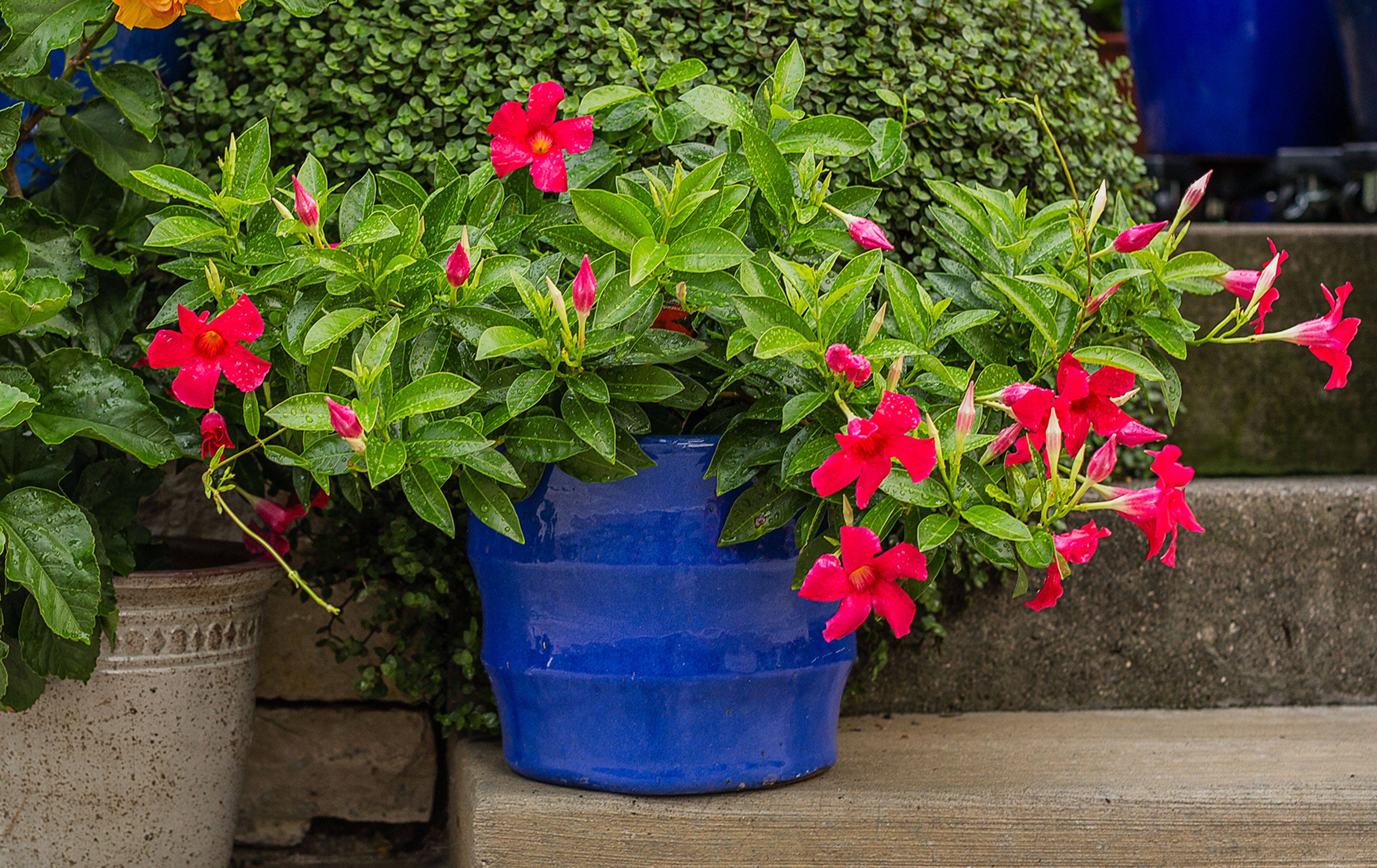
Most people reach for terracotta or black when choosing pots. Nothing wrong with that — but a deep cobalt blue does something quite different. It turns the pink flowers into a genuine colour clash that somehow works, the kind of combination that feels more considered than accidental.
The key here is going bold with the pot rather than playing it safe. If your mandevilla is already a statement plant, the container should be too. Place it somewhere you can see it properly — steps, a doorway, the corner of a patio — rather than burying it in a border where the colour gets lost.
3. Mandevilla Climbing Above a Mixed Patio Planter — Going Vertical
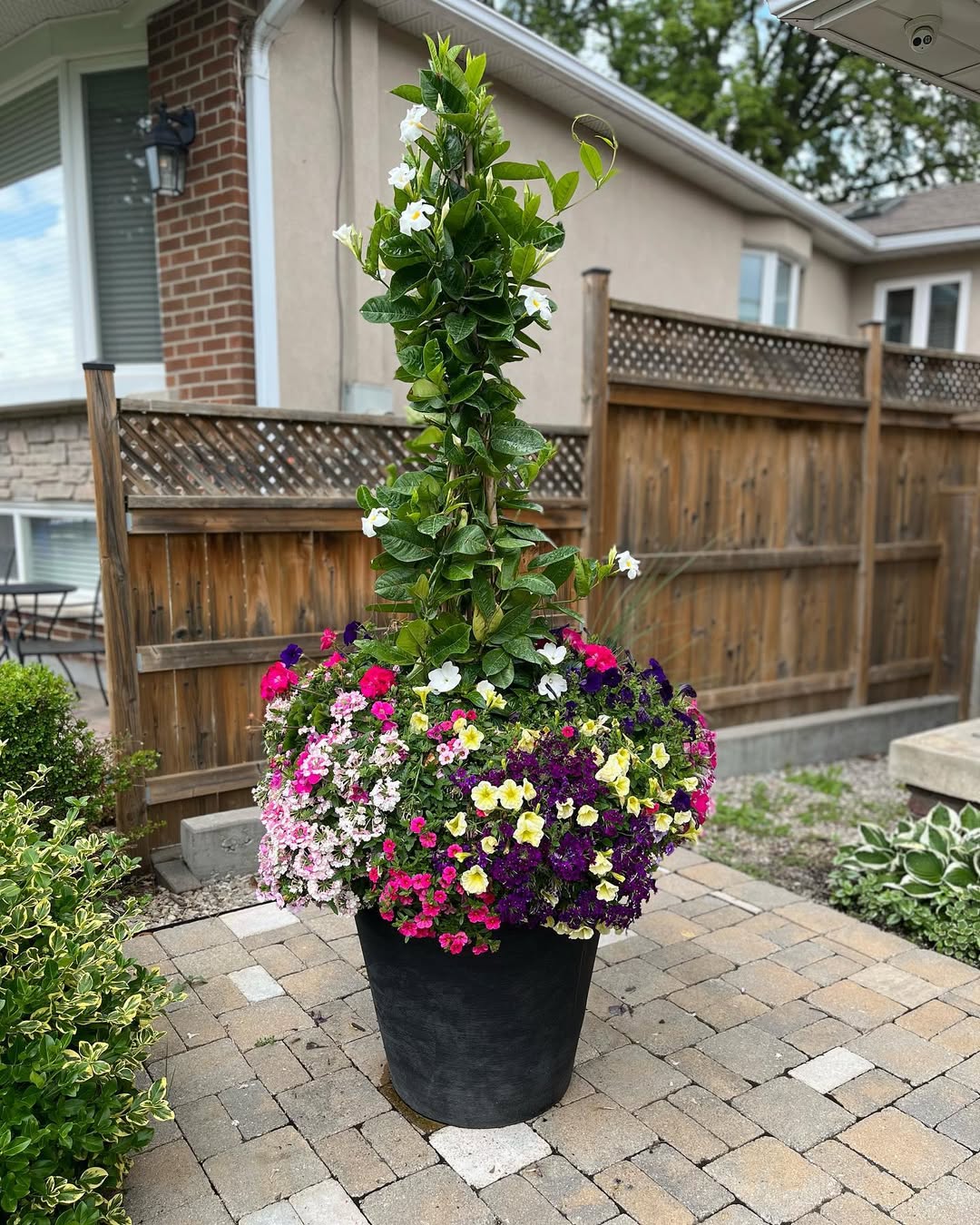
One of the things mandevilla does better than almost any other container plant is height. Let it climb and it pulls the eye upward, making a patio feel taller and more planted-up than it actually is. Pair it with a lower mixed planter at the base — some trailing colour, a bit of texture — and you’ve got a genuinely layered display.
The trick is giving the mandevilla something firm to climb early on. A bamboo teepee or simple wooden trellis tucked into the pot works well. Once it gets going it moves fast, so you’ll have that vertical impact within a few weeks of the growing season getting started.
4. Red Mandevilla on a Stone Plinth — Bold and Architectural
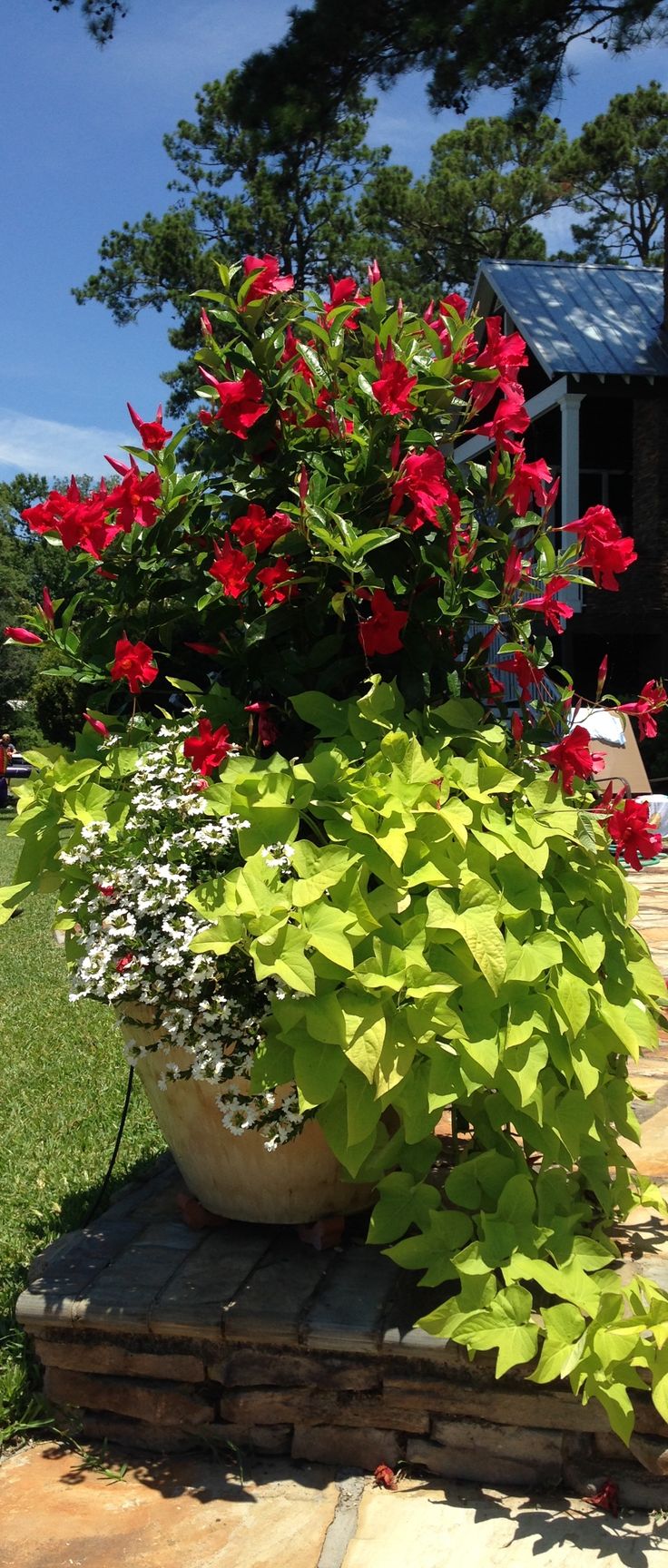
If you want a focal point that earns its place, this is how you do it. The red mandevilla against a plinth of stacked stone reads like proper garden architecture — the kind of thing you’d see at a country house, but done here in a way that’s entirely achievable. The lime green foliage spilling over the edges stops it looking too stiff.
Red mandevilla tends to flower just as prolifically as the pink varieties but feels more dramatic. Position it somewhere it catches the midday sun and you’ll get the best of the colour — those blooms genuinely glow when the light hits them.
5. White Mandevilla in a Stone Urn — Classic and Unhurried
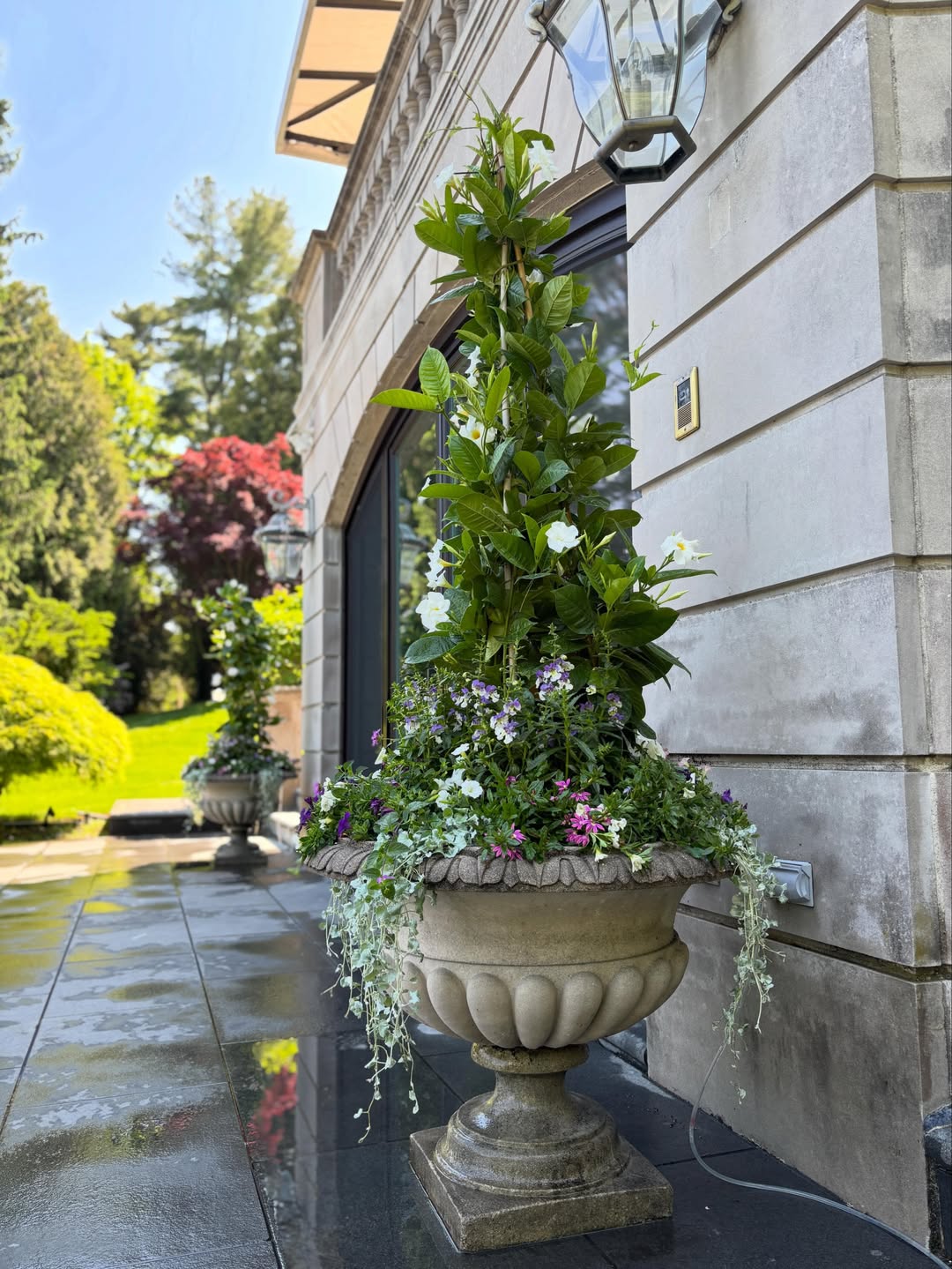
White mandevilla gets overlooked next to the showier pinks and reds, which is a shame. There’s something genuinely elegant about those creamy trumpet flowers with their soft yellow centres climbing out of a weathered stone urn — it doesn’t shout, it just looks quietly right.
This kind of planting works especially well in gardens with a lot of hard landscaping. The white flowers soften the stone, and the overall effect feels more like a garden that’s been considered over time than something thrown together for the summer.
6. Who Needs Wall Art When Your Mandevilla Does This?
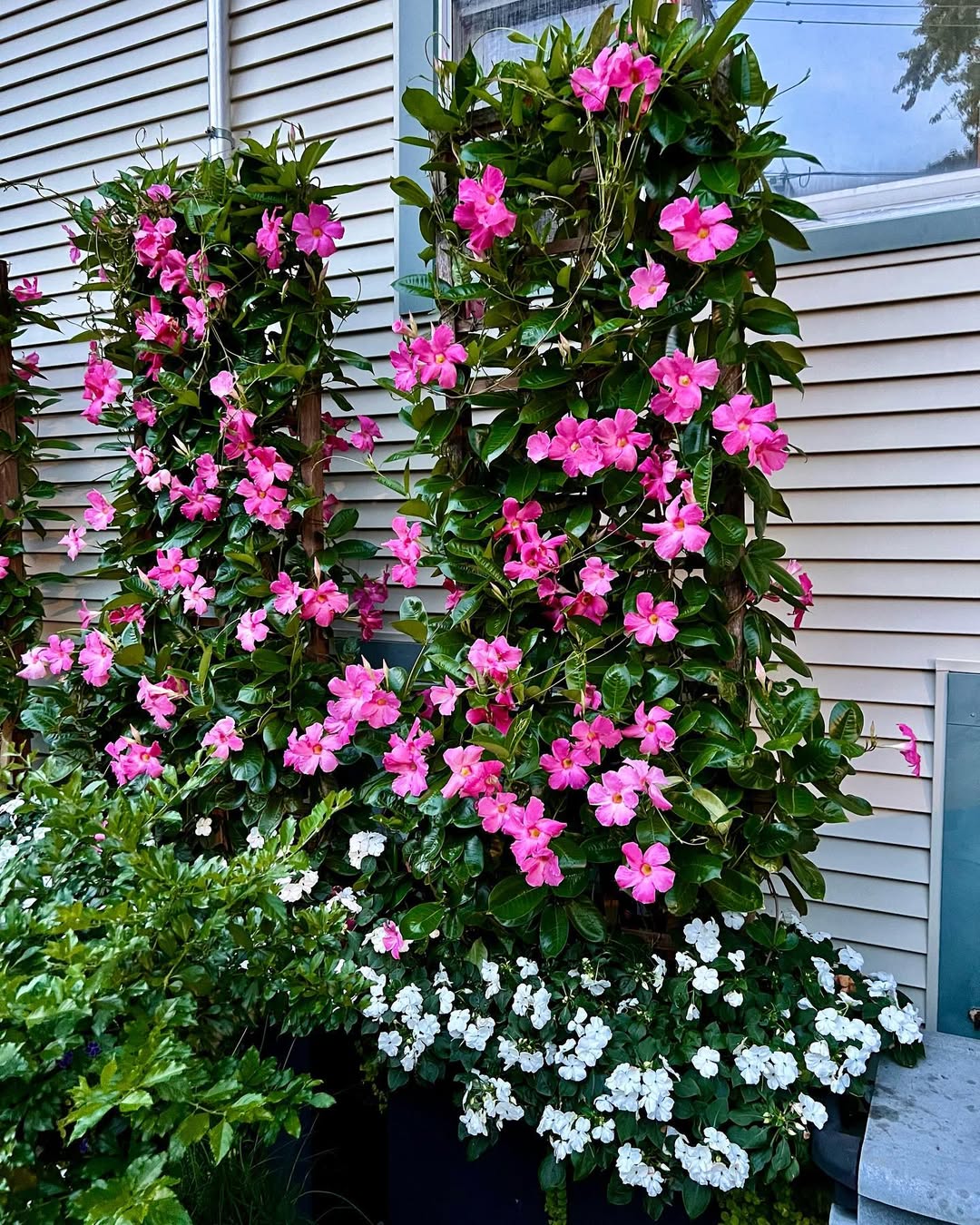
A blank rendered or clapboard wall is usually dead space in a garden. Train a mandevilla up it and suddenly the whole wall becomes part of the planting. The dense coverage you get from a well-established plant is genuinely impressive — solid green punctuated by waves of pink all season.
You’ll need to fix some training wires or attach trellis panels to give it purchase, but once the roots are established the plant does most of the work. This approach suits narrow spaces where a freestanding planter would be impractical — it uses vertical space that would otherwise be wasted.
7. Mandevilla Planter in Full Summer Bloom
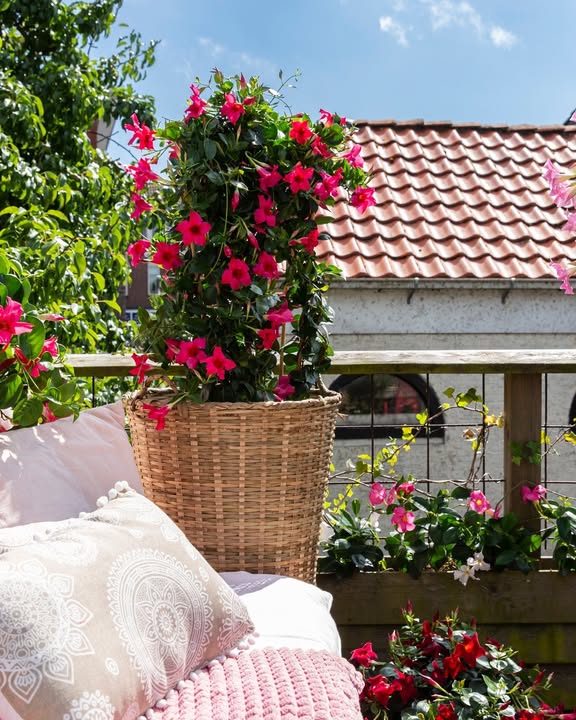
Sometimes a mandevilla just needs room to do its thing. A generous pot, a warm wall behind it, a bit of support to climb — and by midsummer you’ve got this. The flowers at peak bloom are relentless; as one fades the next is already opening, which is why these plants look good for so much longer than most summer flowering choices.
If you’ve been hesitant about trying mandevilla because you assumed it would be tricky, this is the reassurance you need. In a container with decent compost and a fortnightly liquid feed, it’s about as easy as summer colour gets.
8. A Weathered Pot Makes the Colours Hit Differently
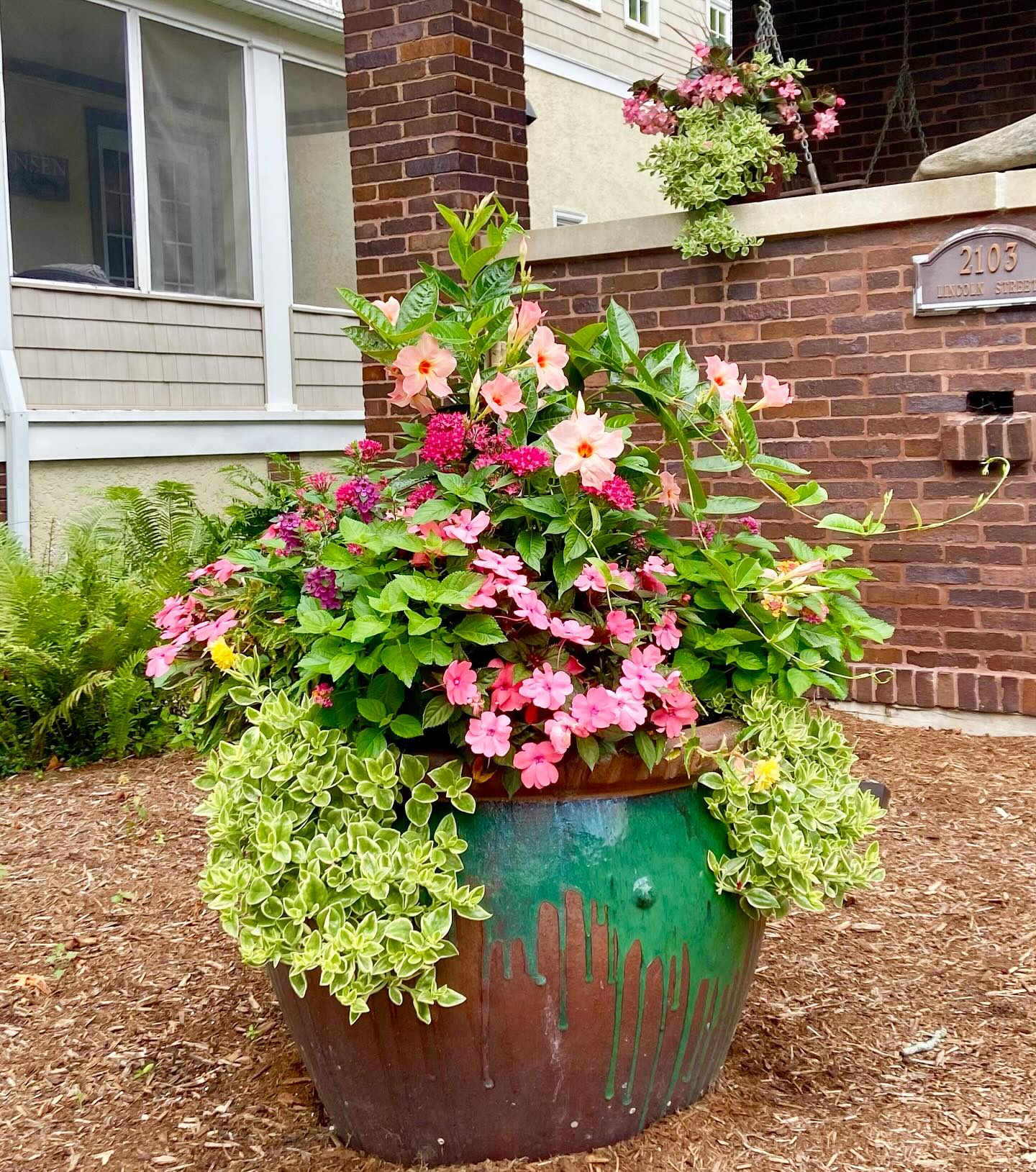
There’s something about a well-worn, slightly patinated pot that makes bright flowers look even better. The contrast between a battered container and fresh pink blooms feels more alive than a brand new pot ever would. This is the kind of thing charity shops, reclamation yards, and skips are made for — hunt out something with a bit of age and character rather than reaching for the garden centre shelf.
The variegated ivy trailing over the edges here adds another layer of interest and softens the whole arrangement. A few purple companions tucked in at the base give it depth. It’s a relaxed, layered approach that suits a cottage-style space particularly well.
9. A Trellis, a White Pot and a Sunny Spot — That’s All It Takes
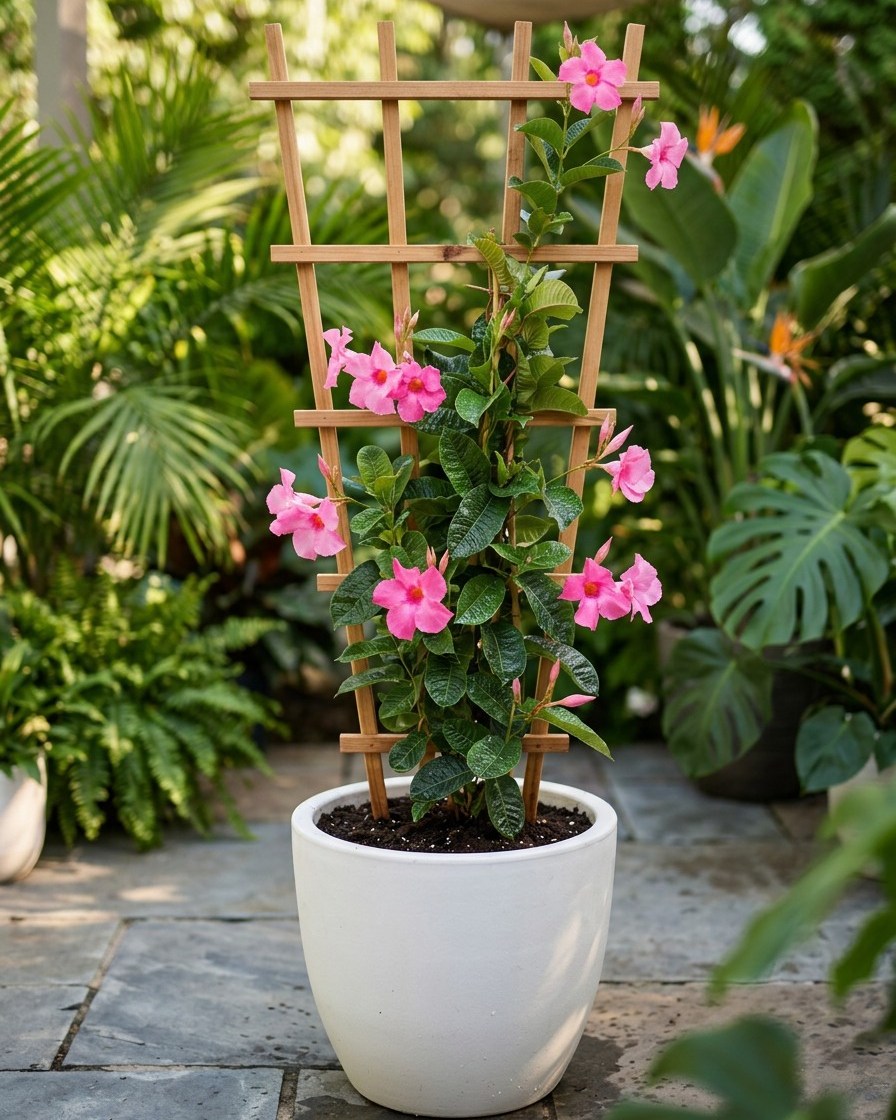
For anyone who wants great results without overthinking it, this is the setup. White pot, wooden trellis pushed firmly into the compost, mandevilla planted at the base and gently tied in as it grows. That’s genuinely it. The plant takes care of the rest.
What makes this work as well as it does is the simplicity — nothing competes with the flowers. The glossy dark leaves and bright pink blooms do all the talking. It’s a formula that works on a balcony, a front doorstep, or tucked into a patio corner, and it doesn’t require anything more than regular watering and a sunny spot.
10. Mandevilla Next to the Patio Furniture — Summer Sorted
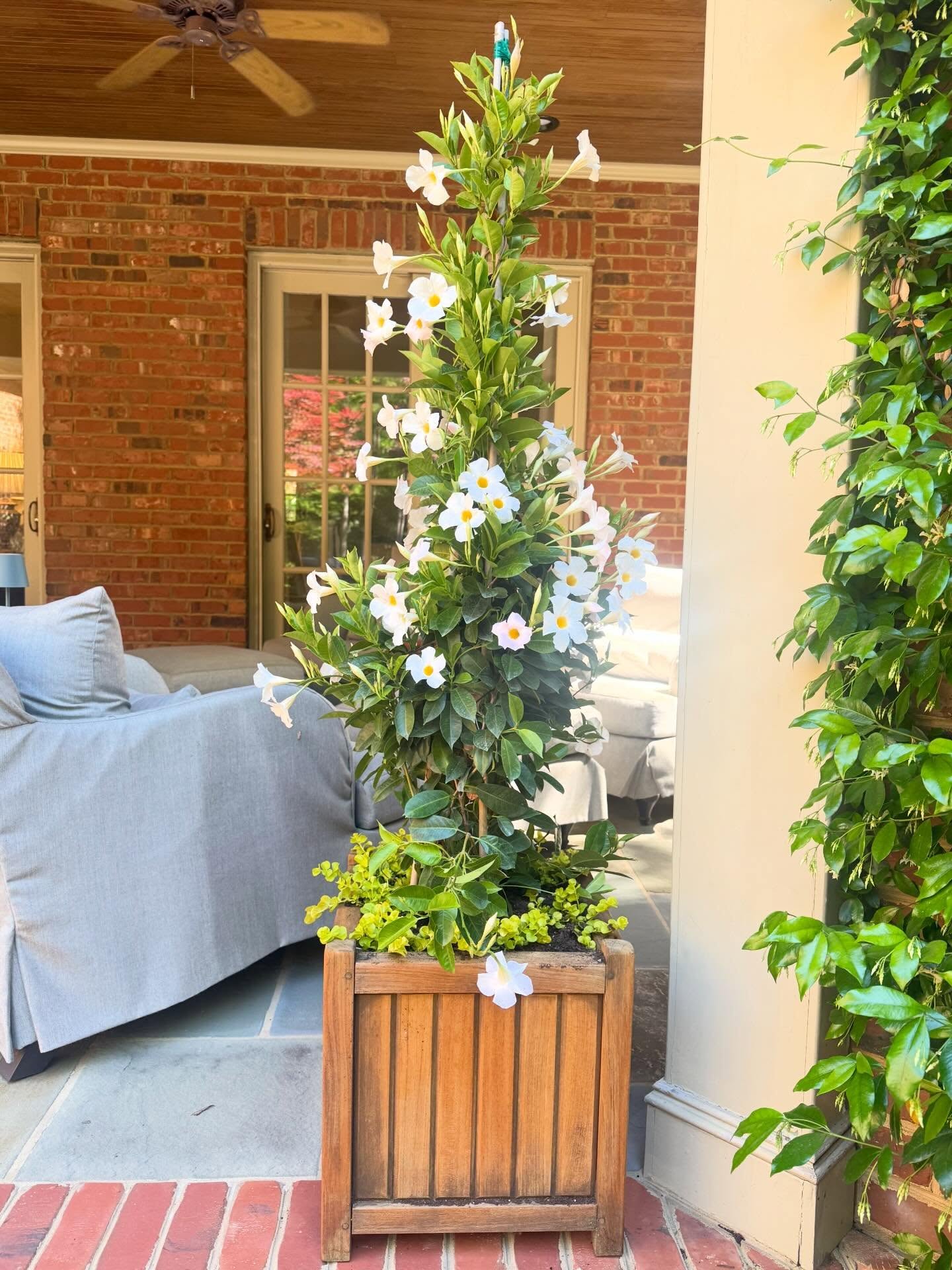
The white mandevilla here is doing something specific — it’s softening an exposed brick wall and giving the seating area something living to look at rather than just a hard surface. That’s one of the most underrated things a single well-placed container can do for a patio.
If your outdoor space feels a bit stark or unfinished, a tall mandevilla in a wooden planter beside the seating can change the whole feel of it. The vertical growth creates a sense of enclosure without blocking light, and because the flowers keep coming for months, it earns its place all season.
11. Mandevilla Planter Ready for Summer
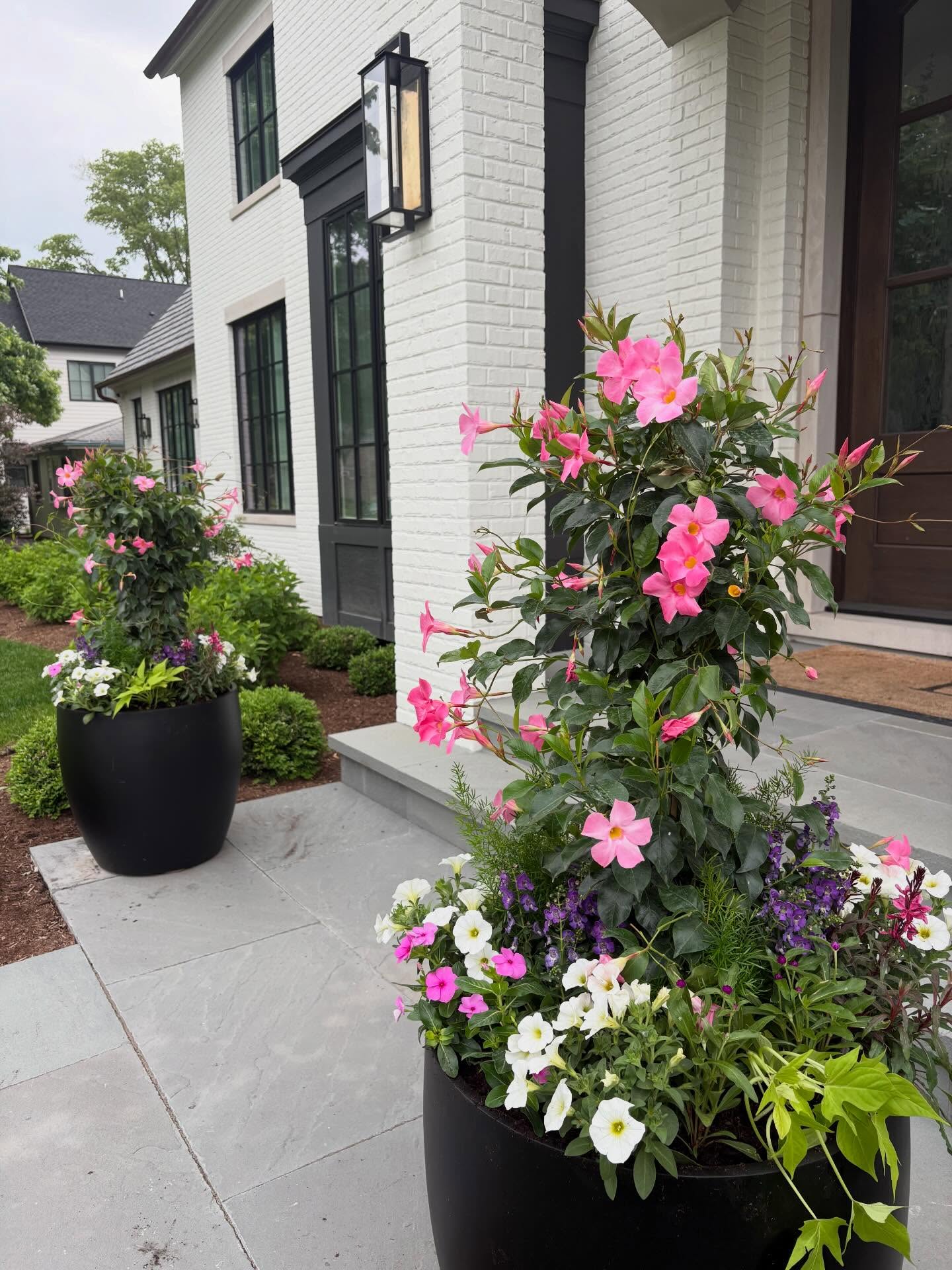
Getting a mandevilla established early in the season is the difference between a plant that trickles into bloom and one that absolutely goes for it by July. Start it off somewhere warm and sheltered, get the roots comfortable in a well-draining compost mix, and give it something to climb from the start rather than retrofitting support later.
By the time the warm weather properly arrives, a well-prepared mandevilla is already loaded with buds. The payoff for a bit of early season attention is months of colour with very little ongoing effort — just water, feed, and enjoy.
12. Poolside Symmetry That Cost Less Than You’d Think
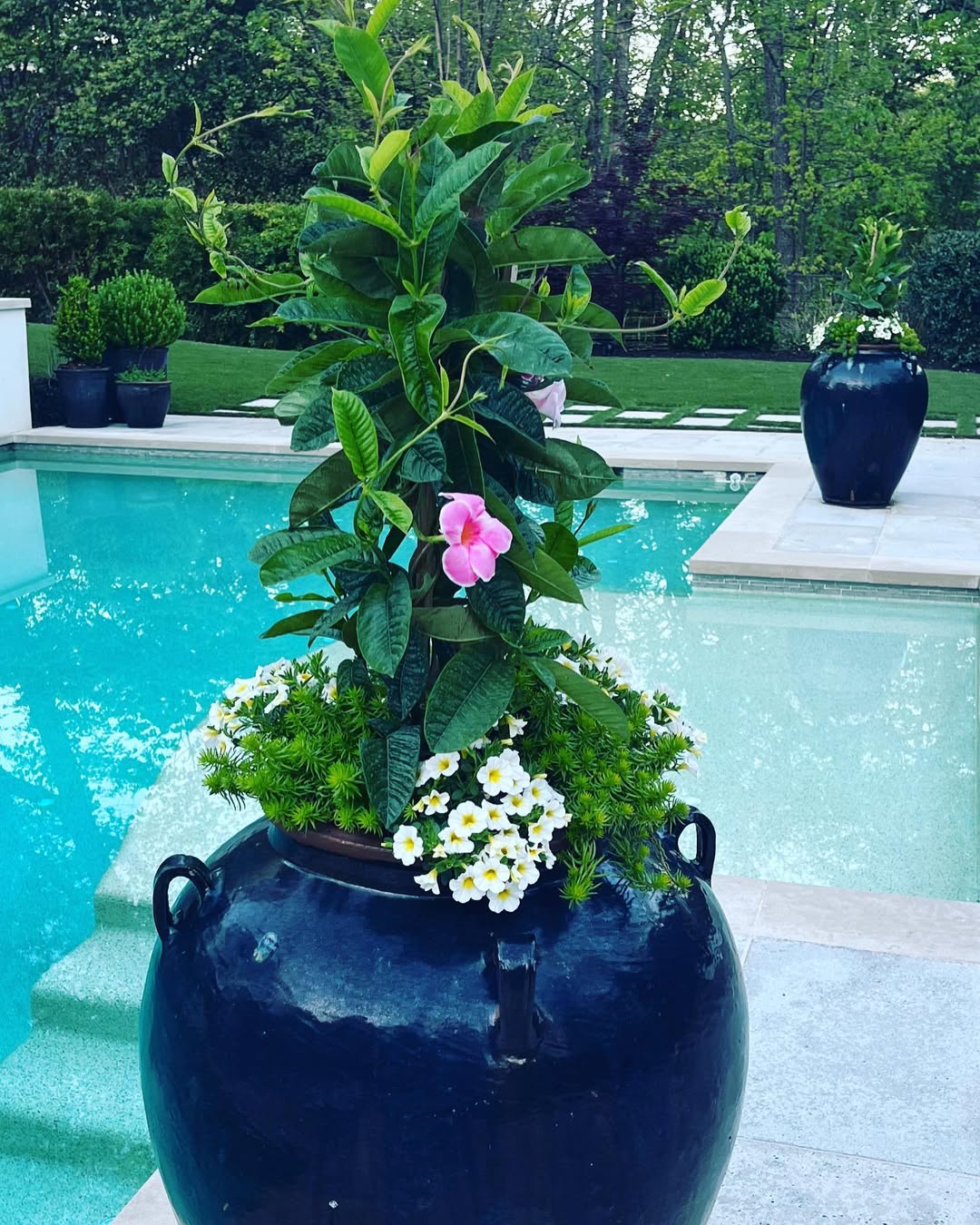
Paired pots either side of a pool sounds like something that would cost a fortune to achieve. In practice, two identical glossy black containers and a couple of mandevilla plants is all it takes. The symmetry gives the whole space a finished, resort-like quality — the kind of thing that looks like it was professionally landscaped but genuinely wasn’t.
Mandevilla holds up well in the bright, reflected light near water. The glossy leaves don’t scorch the way some plants do, and the flowers look fantastic against the turquoise of a pool. If you want your garden to look properly put together this summer, matching poolside pots are one of the higher-impact, lower-effort moves available.
13. The Entrance That Makes Visitors Stop Before They Even Ring the Bell
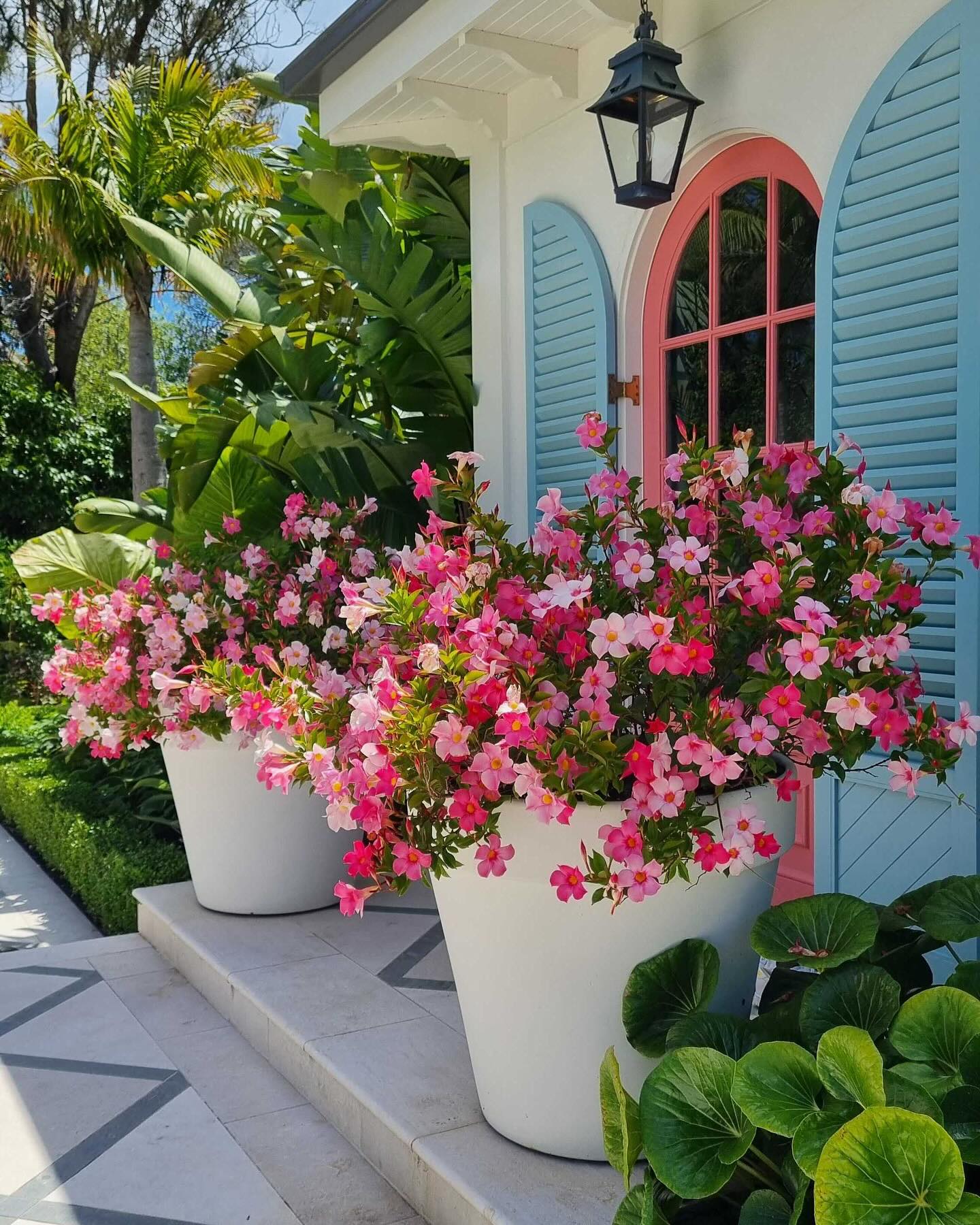
The coral door and blue shutters here would be striking on their own. Add two large white planters overflowing with pink and white mandevilla and the whole entrance becomes something people actually notice and comment on. That’s the power of getting the planting right at the front of a house — it changes the entire first impression.
Mandevilla is genuinely one of the best choices for an entrance display because it flowers for so long. Unlike bedding plants that need replacing or roses that have one big flush and then quiet down, a healthy mandevilla keeps producing from late spring right through to the first frosts.
14. A Turquoise Door and Pink Blooms — Colour Confidence at the Front Door
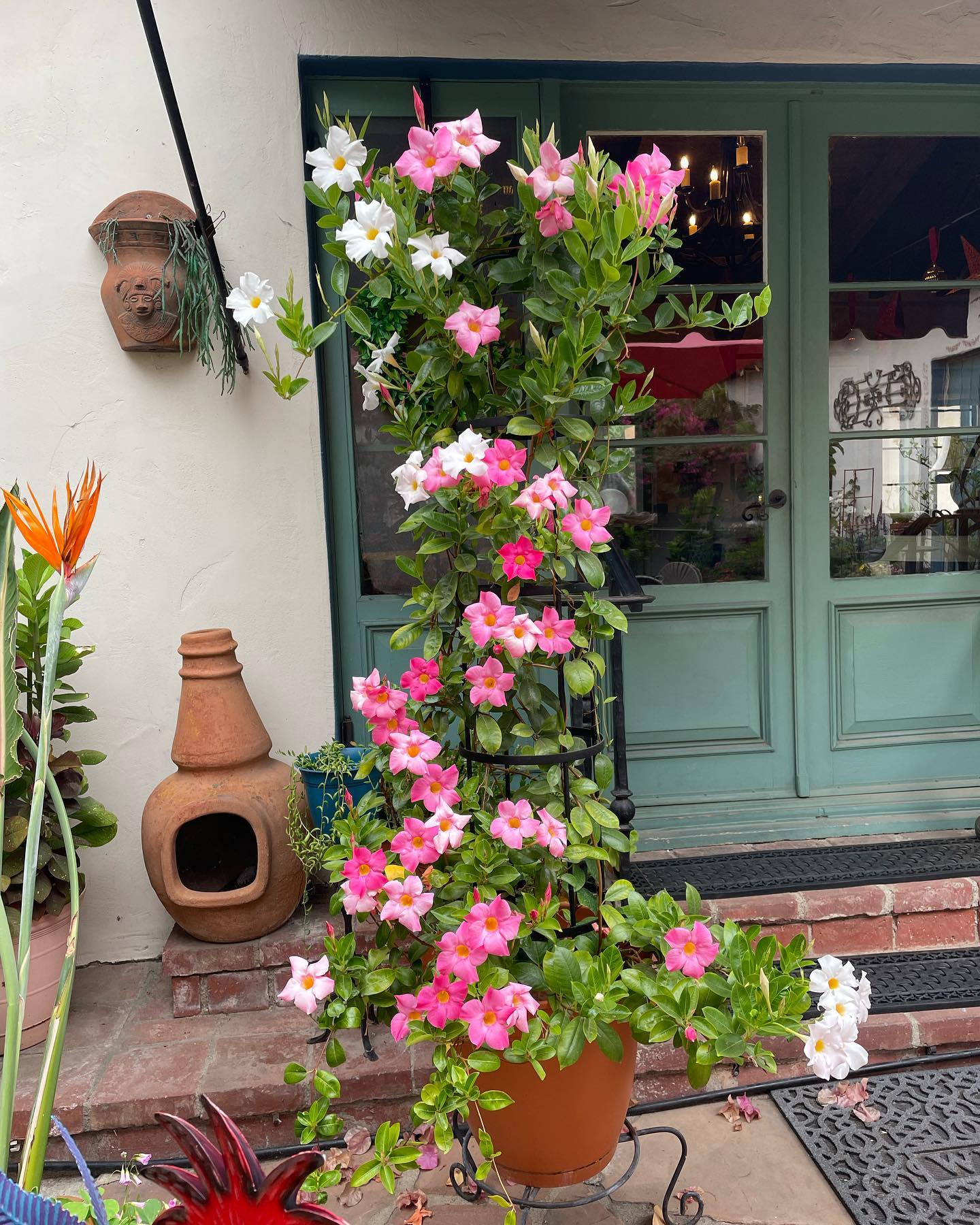
This is what happens when you stop playing it safe with colour. A turquoise door against warm terracotta pots and hot pink mandevilla blooms shouldn’t work on paper — but it absolutely does. It feels like the Mediterranean, or a well-travelled house that has no interest in being beige.
The metal trellis pushed into the pot gives the mandevilla the support it needs while keeping things tidy. The chiminea alongside hints at evenings spent outside enjoying it all. If you’ve been thinking about a bold front door colour, use this as evidence that the plants can absolutely hold their own alongside it.
15. The Planter That Makes a Brick Wall Look Intentional
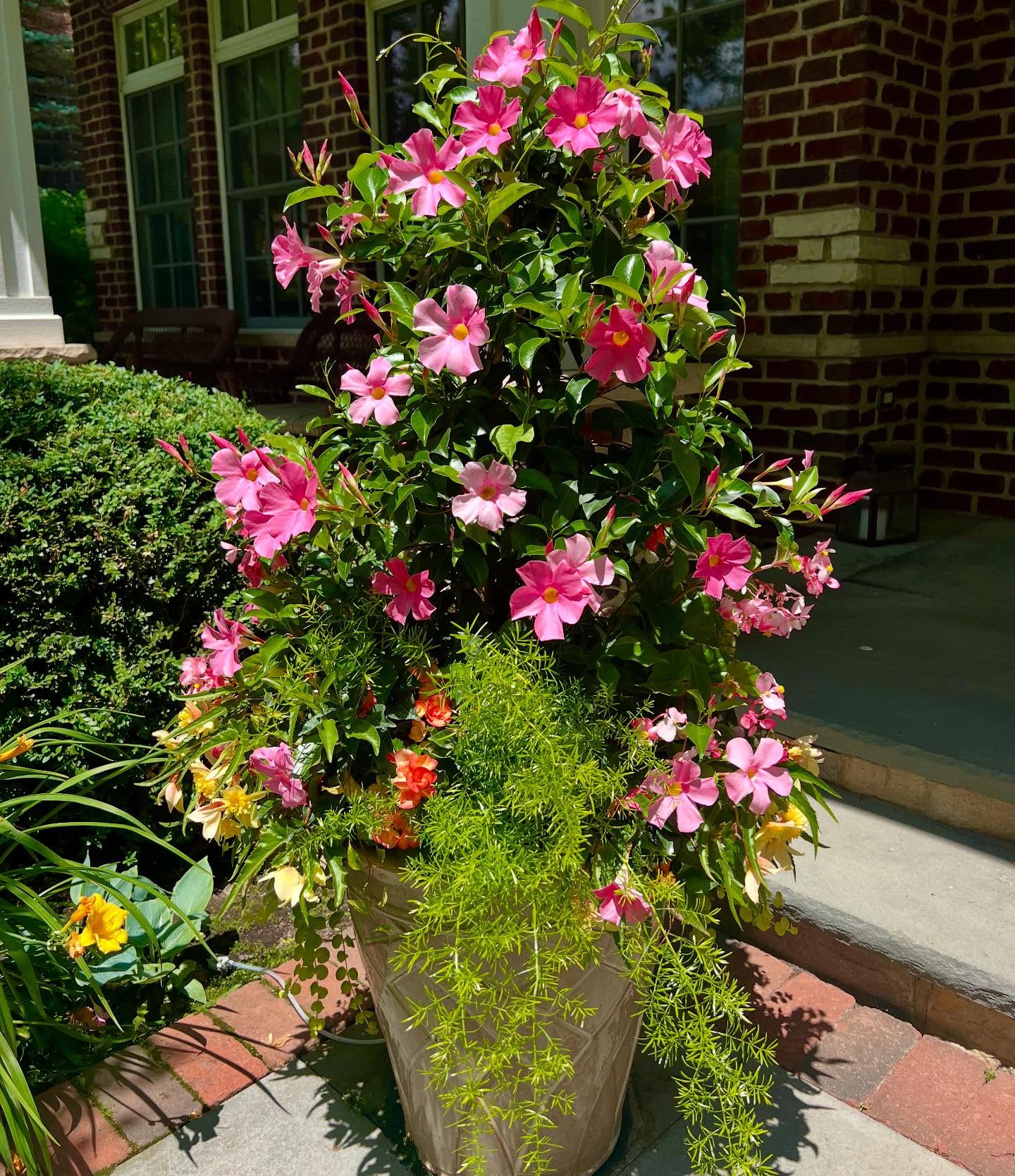
A red brick wall is a beautiful thing, but it can feel like a backdrop waiting for something. A large mandevilla planter positioned in front of it gives the wall a purpose — suddenly it’s a foil for all that colour rather than just a boundary. The warm pink flowers against warm red brick is a combination that feels completely at home.
The key to a display like this is generosity — a single small plant won’t cut it. Go for the biggest pot you can manage, plant a couple of mandevillas together for density, and give them something to climb. A full, overflowing arrangement rather than a neat, contained one.
16. Dark Fence, Red Blooms — the Contrast That Stops You in Your Tracks
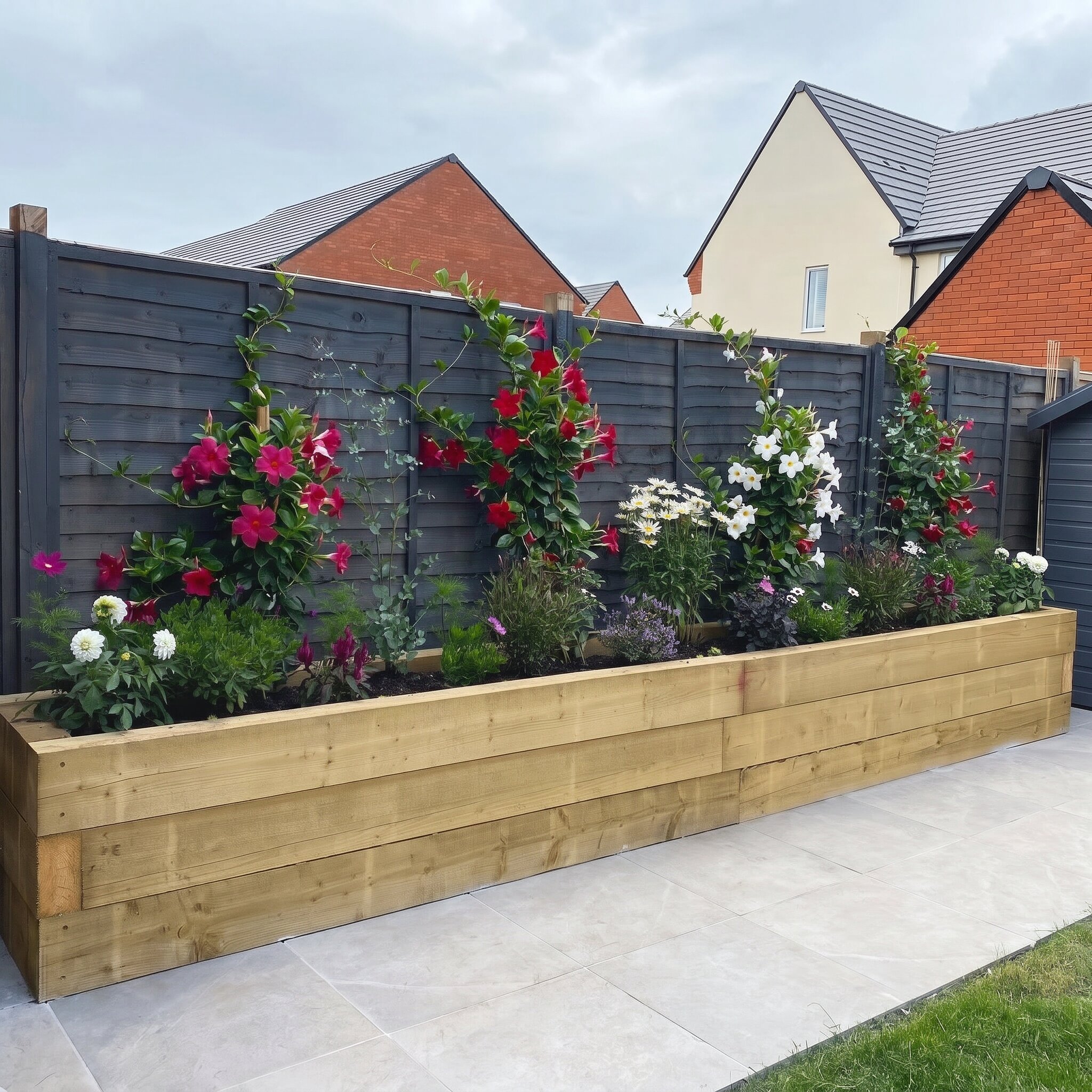
Dark painted fences have become popular for good reason — they recede visually and make everything in front of them look more vivid. Plant a red mandevilla against one and the effect is almost theatrical. The deep charcoal grey throws the bright blooms into sharp focus in a way that a natural wood fence never would.
If you’re planning to paint your fence this year, consider going dark rather than the usual brown. It’s a backdrop that works with almost any flower colour, but mandevilla in particular looks genuinely spectacular against it. This is one of those garden combinations that gets better every time you look at it.
17. Mandevilla and a White Deck — the Garden Doing All the Work
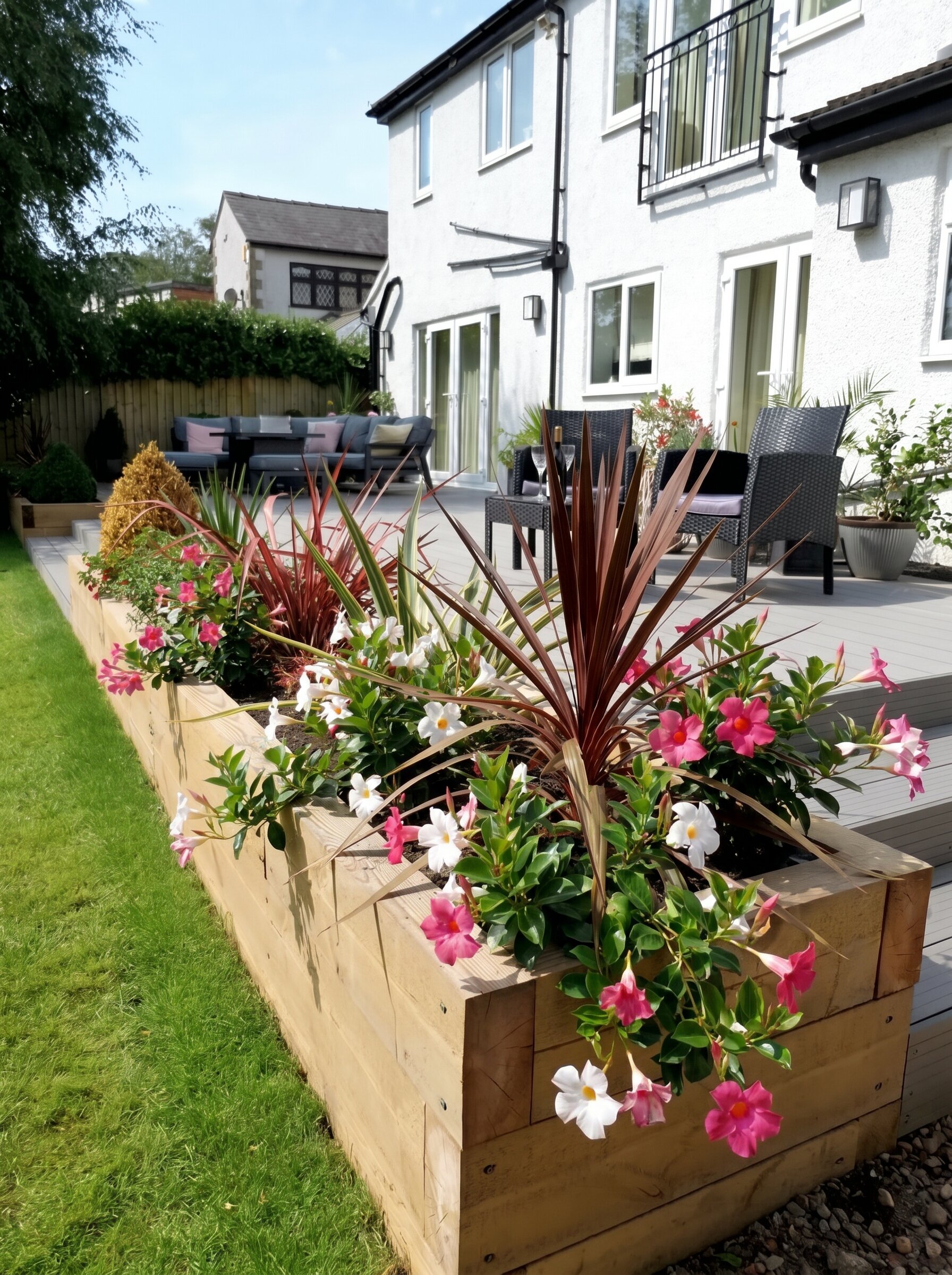
Clean white architecture needs plants with presence — something that can hold its own against all that brightness without getting lost. Mandevilla in rustic wooden planters does exactly that. The spiky contrast planting alongside it stops things looking too pretty-pretty, and the well-kept lawn beyond ties it all together.
This setup works because the garden earns the architecture. The deck is the stage, but the planting is the performance. If you’re working with a newer build or a house with a very clean exterior, don’t be afraid of bold tropical planting — it’s exactly what those spaces need.
18. One Black Planter by the Front Door Changes Everything
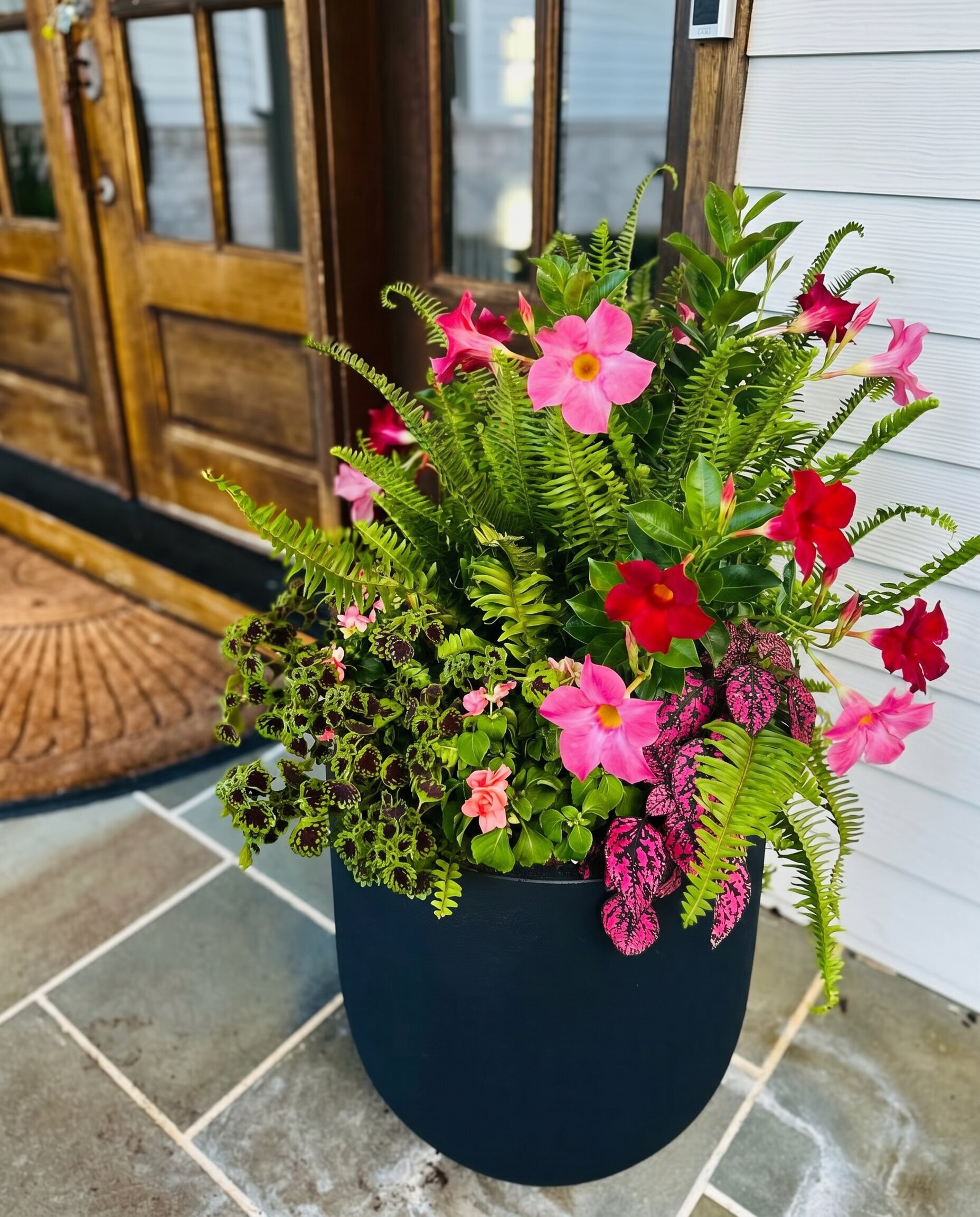
You don’t need an elaborate scheme to make a front entrance look good. A single well-chosen planter — sleek, dark, properly sized — filled with a generous mandevilla is enough. The mix of pink, red and deep green here is lush without being fussy, and the black container grounds it all without competing with the flowers.
The ferns tucked in alongside add texture and stop the arrangement looking one-dimensional. This is a useful reminder that mandevilla doesn’t have to be the only plant in the pot — companions that contrast in leaf shape and colour make the whole display more interesting.
19. Mandevilla Softens a City Street in a Way Concrete Never Could
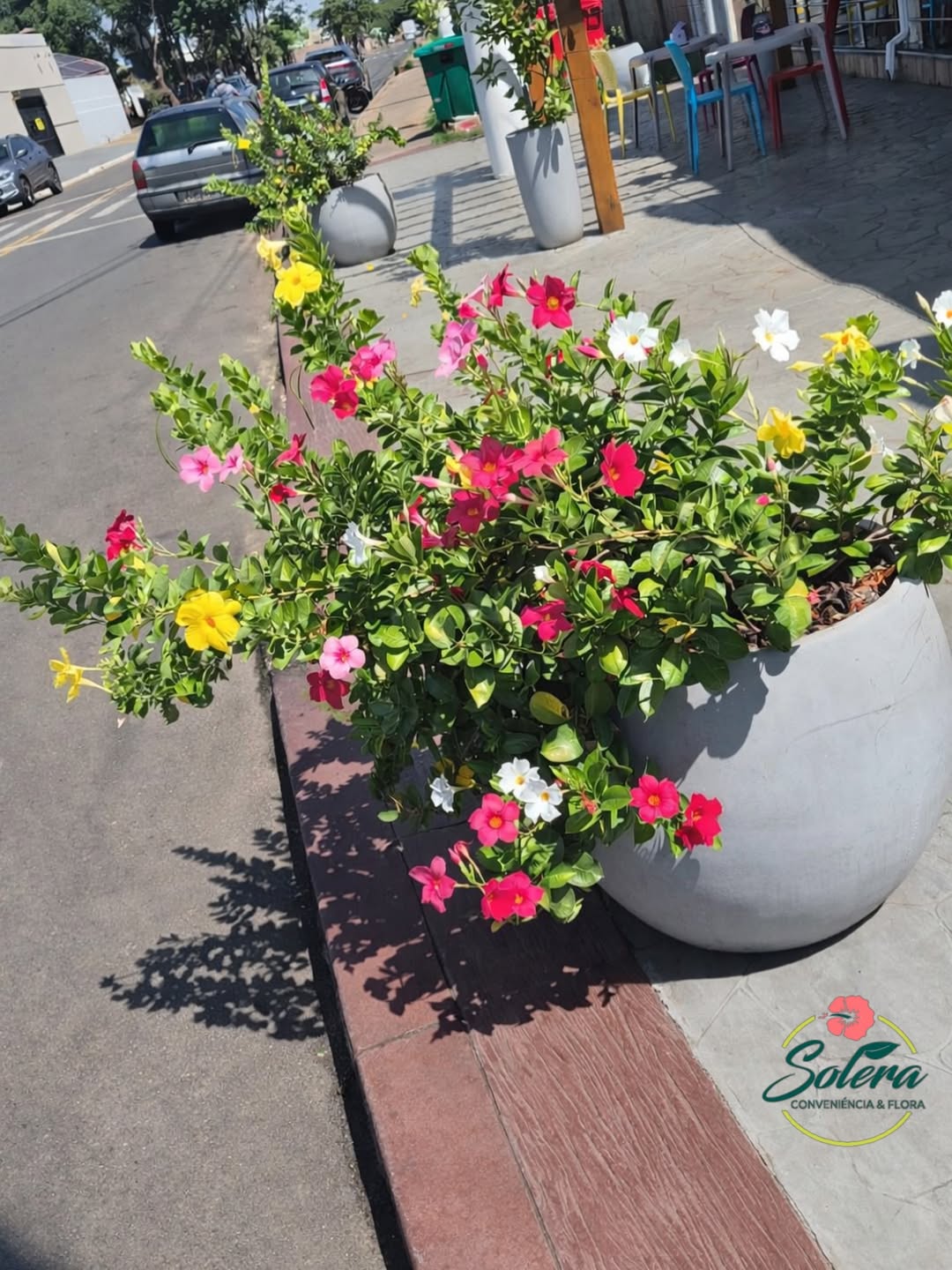
There’s a reason businesses and restaurants use large planters at street level — they completely change how a space feels from the pavement. What’s interesting here is that mandevilla pulls that off better than most planting choices because it flowers so consistently and so abundantly. These aren’t planters that look good in May and tired by August.
The scale matters. Large, confident containers rather than small, apologetic ones. Enough plants in each pot to create real density. The result is something that softens a hard urban environment in a way that a couple of sad geraniums in a window box never would.
20. Small Corner, Big Colour — Mandevilla Earns Its Keep
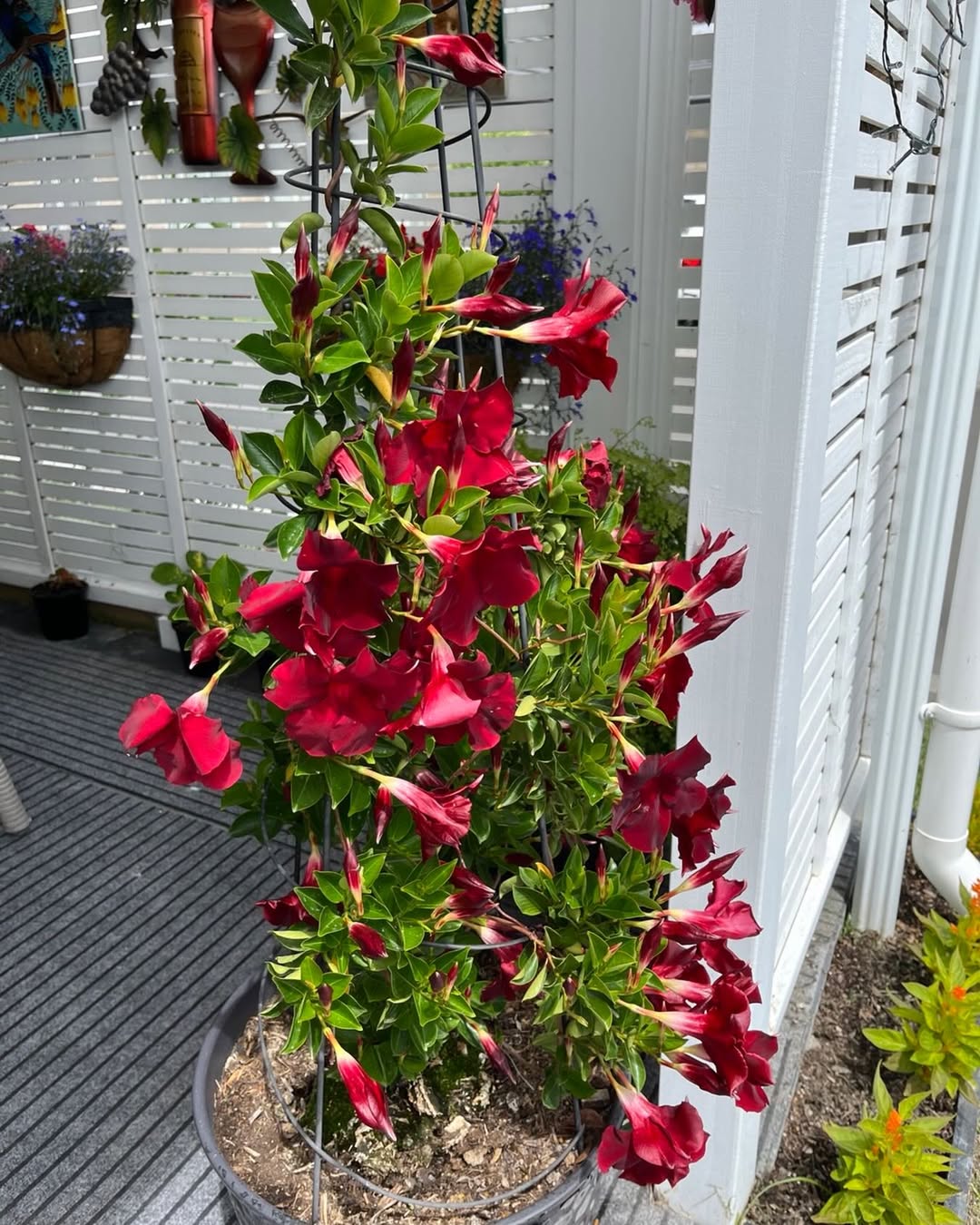
Limited space is no barrier with mandevilla. A single pot in a tight corner, a simple metal trellis for support, and within a few weeks you’ve got colour climbing the wall and filling what was previously dead space. The red flowers against white slatted walls here are doing a lot of heavy lifting in what is clearly a compact outdoor area.
This is the real argument for mandevilla in smaller gardens — it grows up rather than out, which means you get maximum impact for minimum floor space. If you’ve been writing off a corner because it seemed too small to bother with, this is proof that one good plant choice can completely transform it.