A sloped garden can feel like a bit of a headache at first. You look out the window and think: what am I supposed to do with that? 😅
Flat lawns are easy. Slopes are… trickier. There’s the mowing (awkward), the rainwater runoff (annoying), and the constant feeling that you can’t quite use the space properly. It’s no wonder a lot of sloped gardens end up neglected.
But here’s the thing – some of the most interesting gardens I’ve seen have been built on slopes. The change in level creates natural structure, lets you play with terraces and steps, and gives you views you’d never get on a flat plot. Once you stop fighting the slope and start working with it, the possibilities open up.
We’ve pulled together a bunch of sloped backyard ideas for different budgets and styles. Some are simple fixes you could tackle yourself; others are bigger projects if you’re ready for a proper transformation. Either way, that tricky slope might just become your garden’s best feature. ⛰️
Let’s get into it.
1. Tiered Circular Planters Turn a Slope Into a Garden Feature

Circular planters arranged in tiers are an unusually effective solution for a sloped area because they work with the gradient rather than against it. Instead of trying to flatten or hide the slope, this approach makes the elevation change the point. The layered effect is visually interesting and the contained planting keeps everything neat without requiring complex landscaping work.
The mix of plant varieties in the different tiers — varying textures, leaf shapes, heights — gives the arrangement the quality of a considered display rather than a practical fix. The wooden fence providing a warm backdrop stops the planters looking isolated. This kind of setup is achievable without professional help and can be adapted to almost any gradient, making it one of the most accessible approaches for a difficult sloped area.
2. Natural Stone Steps With River Rock Edging: A Path That Earns Its Place
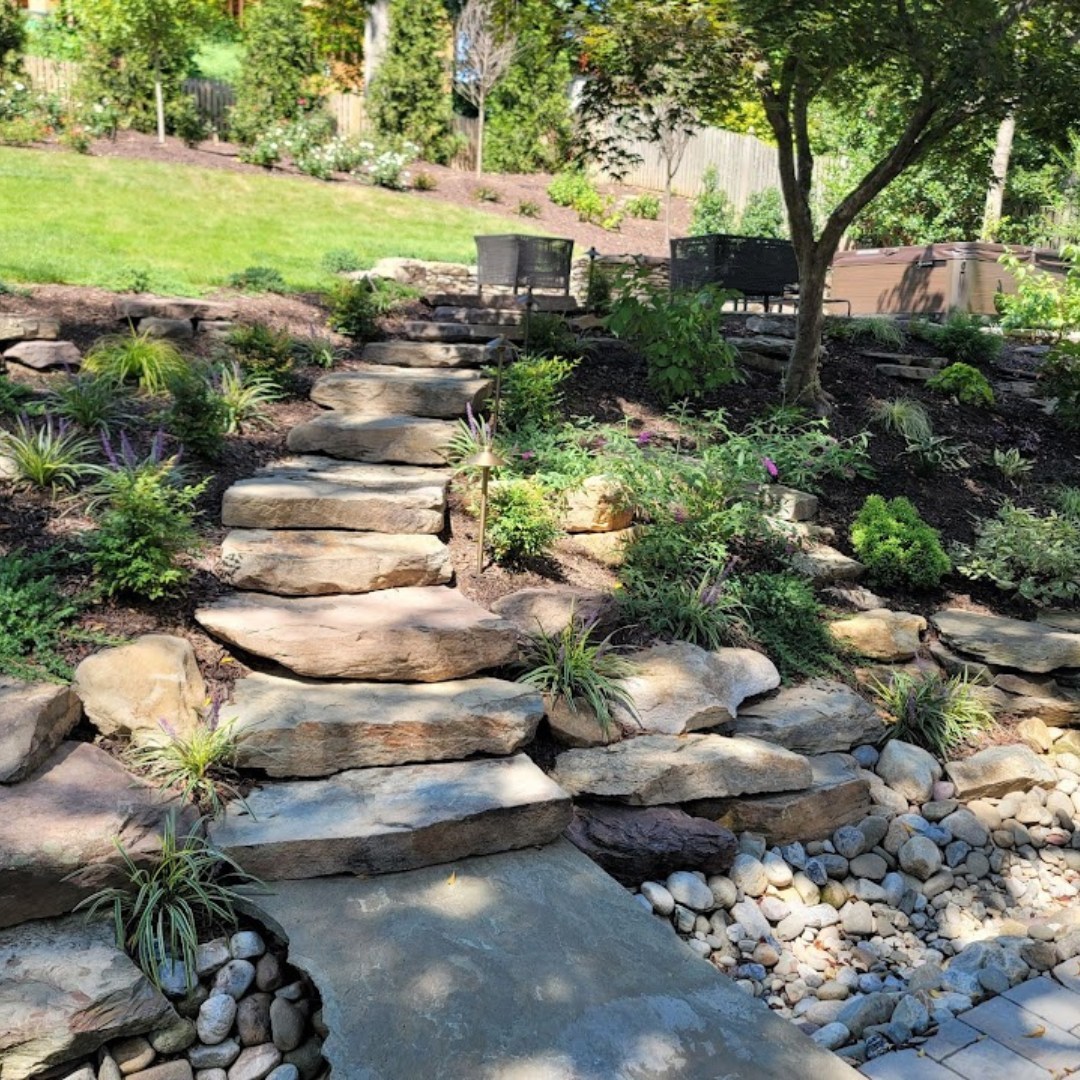
The most useful thing you can do with a sloped garden is make it navigable, and a well-built set of steps does that while simultaneously becoming one of the garden’s most attractive features. These natural stone slabs set into the earth have a quality of permanence that feels genuinely planted in the landscape rather than placed on top of it — which is exactly what good hard landscaping should achieve.
The river rock edging alongside the steps is the detail that elevates this from functional to considered. It creates a clear distinction between path and planting without the rigidity of a cut stone edge, and the smooth rounded stones soften what could be a very linear feature. The planting on either side — ornamental grasses, low shrubs, flowering perennials — fills in the slope without requiring any soil engineering to hold it in place.
3. Terraced Levels, a Hammock and a Dark Shed: Making the Most of Every Tier
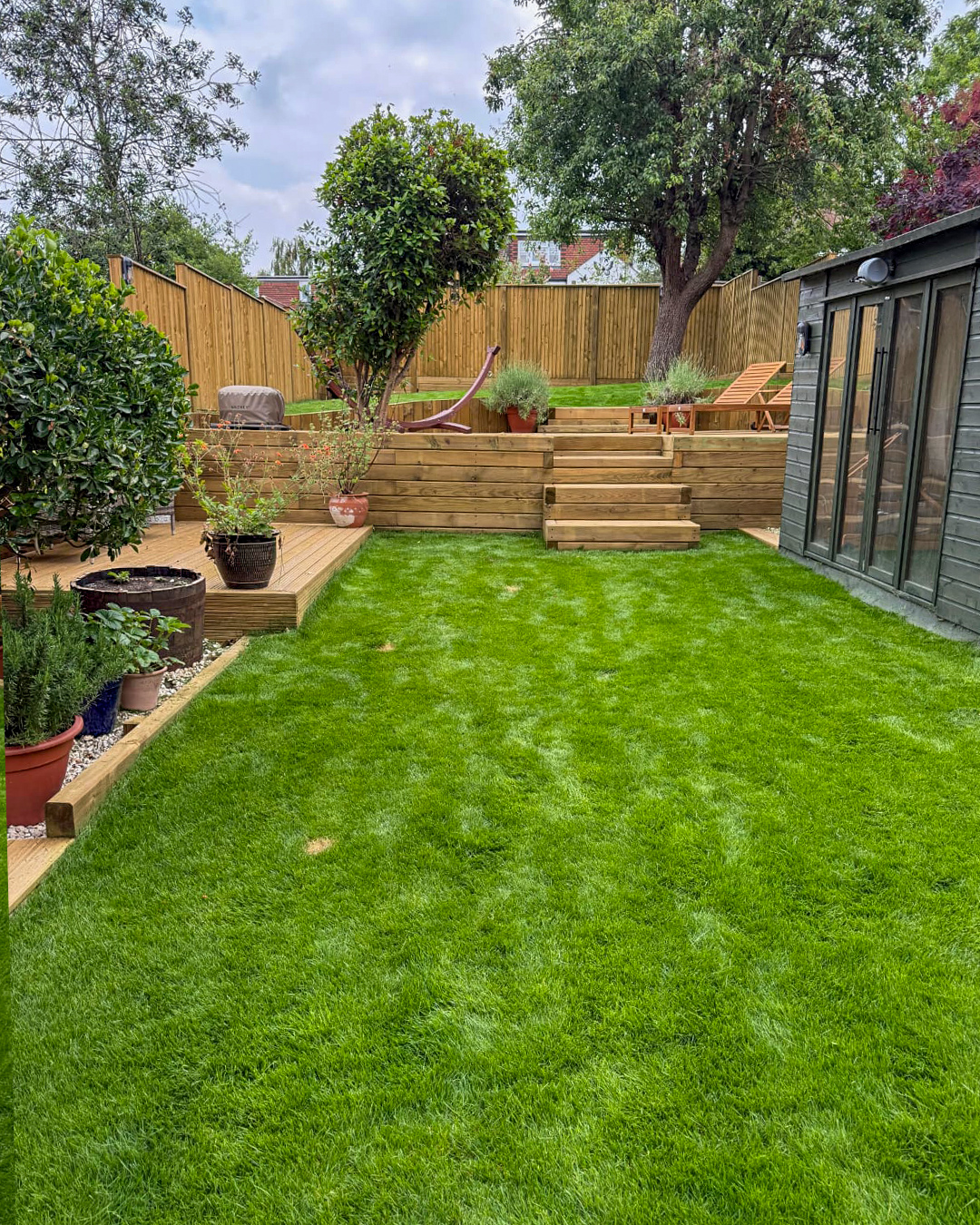
One of the genuine advantages of a sloped garden over a flat one is that terracing creates multiple distinct zones, each of which can serve a different purpose. This garden shows that principle working well: a lawn level for playing and lounging, a deck level for seating and container plants, the slope itself managed with wooden planters and steps. The whole garden is more interesting than it would be on a flat plot.
The dark shed is worth noting as a deliberate design choice rather than an afterthought. Dark-painted structures recede visually rather than dominating, which means they make the garden feel larger and the planting more prominent. A hammock strung between trees converts what might just be a corner of the garden into a destination — a small detail that makes the whole space more usable and more enjoyable to be in.
4. Gravel Steps Through Lavender: The Low-Maintenance Slope Solution
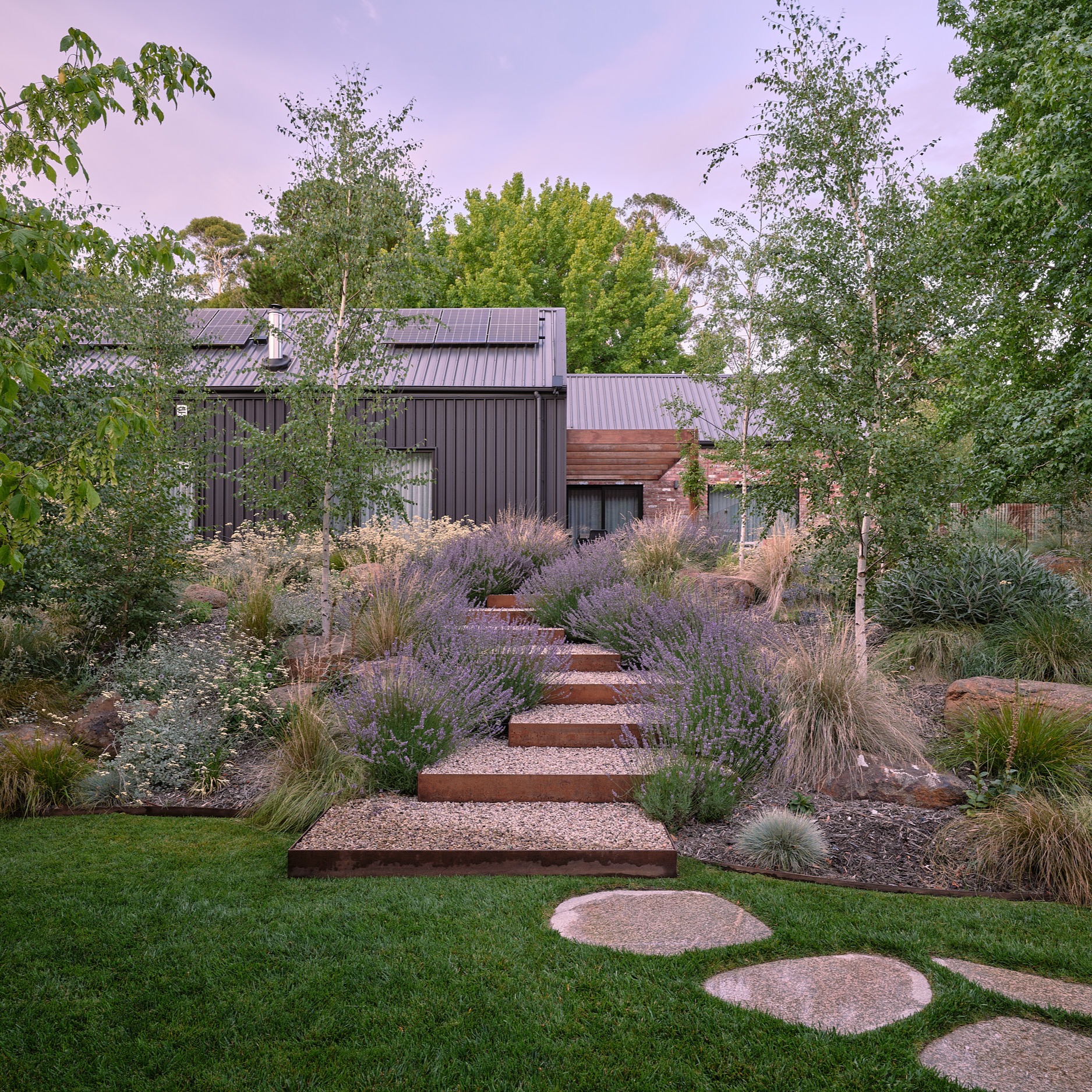
Gravel steps cut through lavender planting is one of the most practical and visually satisfying approaches to a gentle slope. The gravel is cheaper and easier to install than cut stone, it drains well (important on a slope where water runoff is already a concern), and it develops an appealing patina with age. The lavender on either side does the work of stabilizing the slope while looking good and requiring very little attention once established.
The contemporary house behind this garden shows how a naturalistic slope treatment can sit comfortably alongside modern architecture. There’s sometimes an assumption that sloped gardens need to be heavily engineered to suit a modern home, but this combination of gravel, lavender and large flat stepping stones in the lawn shows that a relaxed, plant-led approach can work just as well — and for considerably less money.
5. Brick Steps, Slatted Fencing and a Raised Bed: Working the Grade in a Small Yard
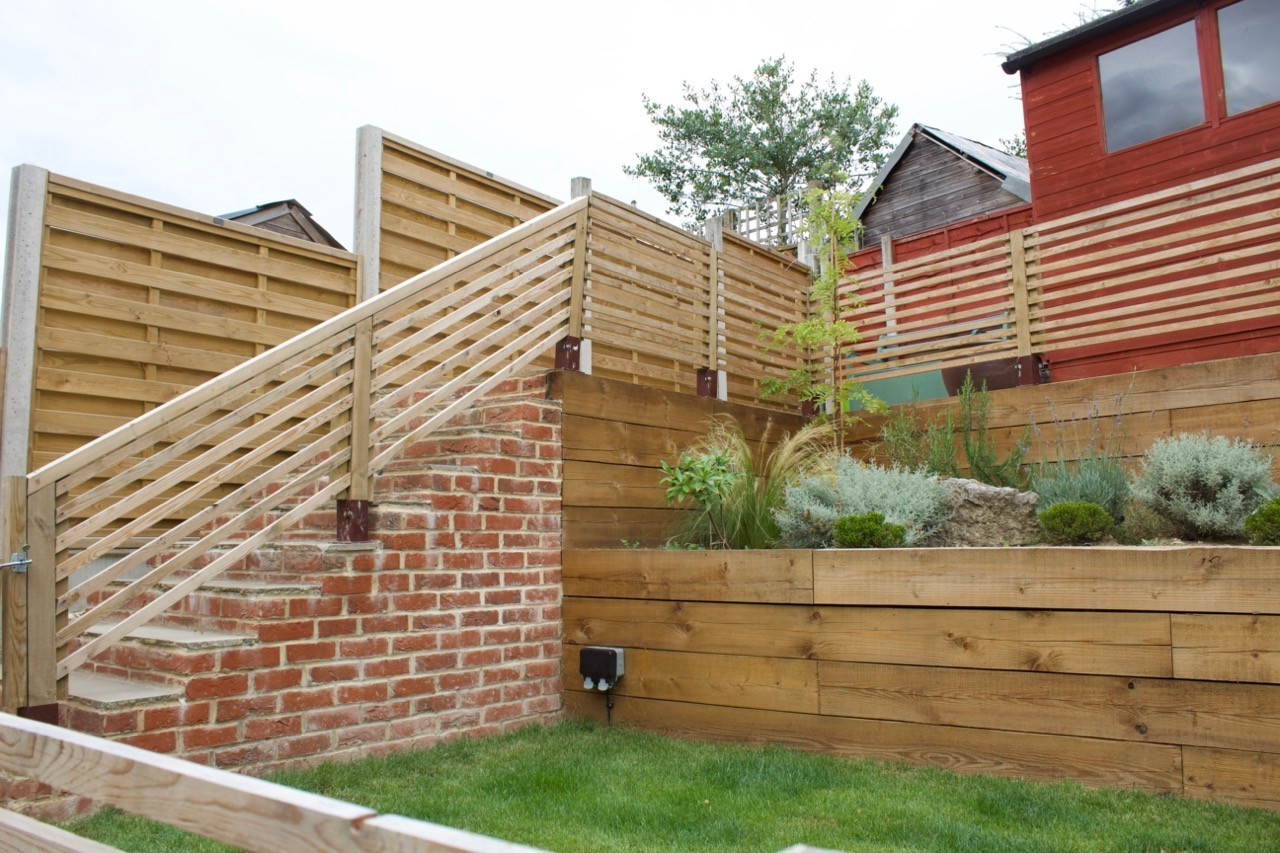
A small sloped yard has less margin for error than a larger plot — there’s nowhere to hide an awkward transition or an ugly retaining wall. This setup handles the constraint well by combining materials that work naturally together: brick steps, timber slatted fencing, and a raised planting bed that uses the elevation change rather than fighting it. Nothing feels imposed.
The red shed providing a color accent against the neutral wood tones is a useful reminder that small gardens benefit from deliberate color moments. A space this size risks feeling grey and functional without something that draws the eye. The raised bed alongside the fence makes practical use of what would otherwise be an awkward strip of soil on the slope, and the varying plant heights add the vertical interest that keeps a compact yard from feeling cramped.
6. Terracotta Steps, Herb Beds and Pebble Edging: The Productive Sloped Garden
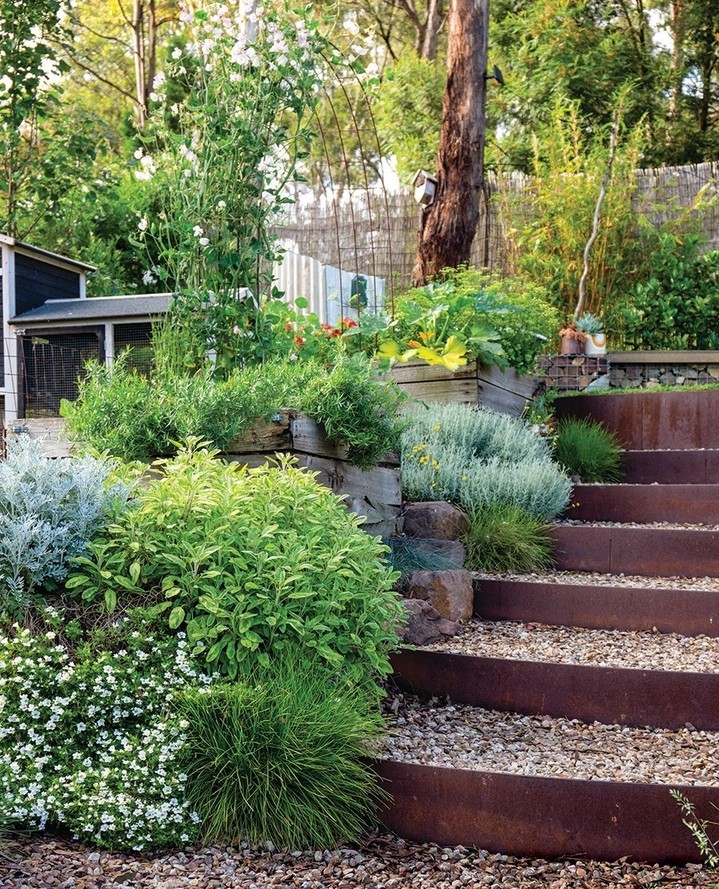
A slope is actually an ideal location for a productive kitchen garden because the terracing that the gradient demands creates exactly the kind of raised, well-drained beds that herbs and vegetables thrive in. Each level becomes a dedicated growing area, easily accessible without bending or kneeling, and the natural drainage that a slope provides means you’re less likely to deal with waterlogged soil.
The terracotta-toned steps here have a warm, earthy quality that suits a productive garden well — nothing too designed or precious, just a practical path through working garden beds. Pebble edging at each level keeps the soil contained and gives the steps clean definition without the cost or labour of cut stone. The slender tree adding height at the back is a useful reminder that even a purely productive garden benefits from some structural planting that isn’t edible.
7. A Woodland Path Through a Planted Slope: When the Whole Garden Becomes the Feature
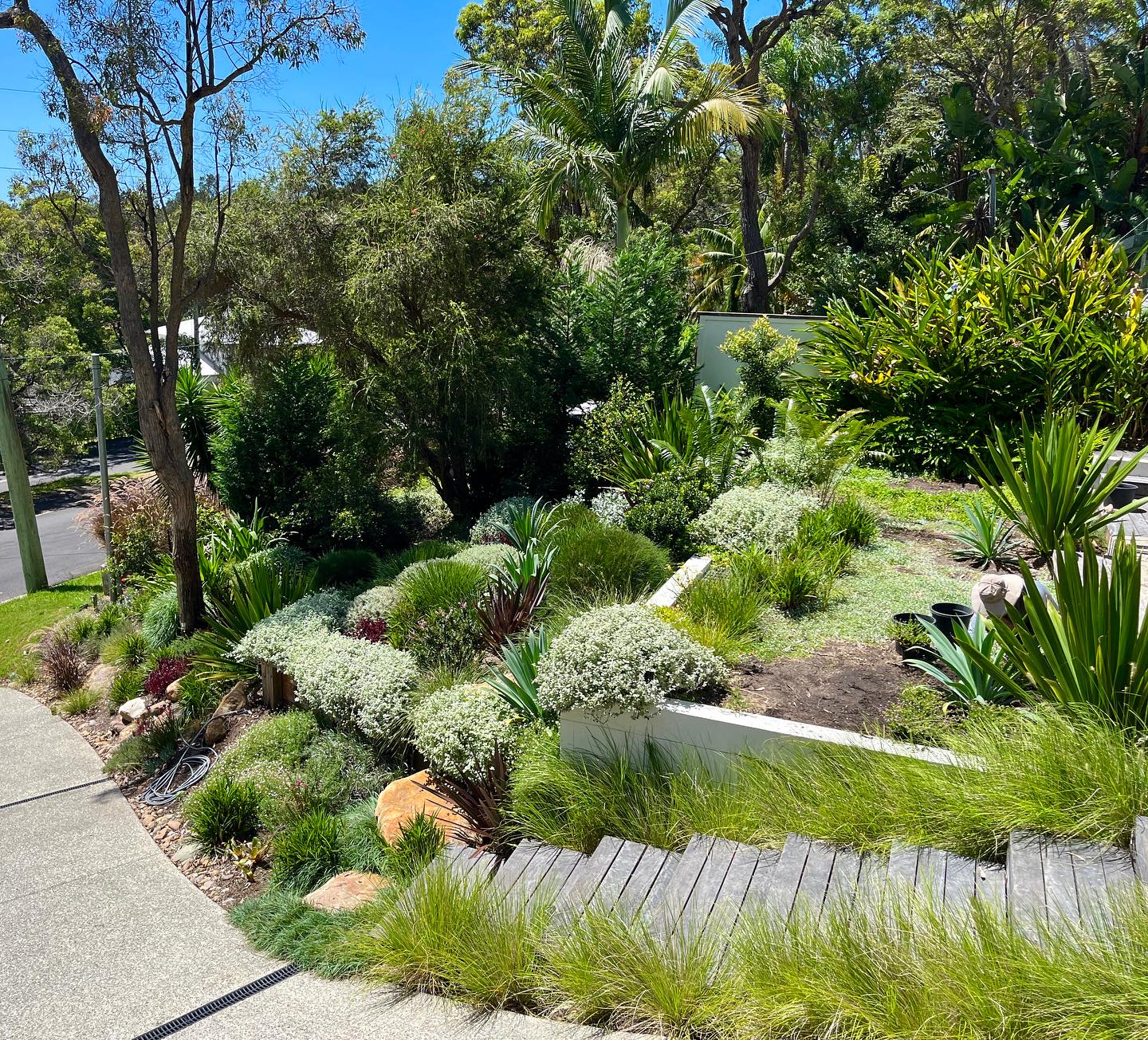
Instead of terracing or retaining, this approach treats the slope as an opportunity for a planted landscape that you walk through rather than manage from a distance. A wooden pathway winding through mixed planting — ornamental grasses, palms, flowering shrubs — transforms a gradient that could have been a maintenance headache into a garden that feels genuinely immersive. The slope becomes the reason the path winds rather than an obstacle to navigate.
The variety of textures and the mix of light and shade created by the different plant heights is what makes this work. A uniform planting on a slope reads as a bank; a varied, layered planting reads as a garden. The sunlight filtering through the taller plants and casting shadow across the path is an effect you’d never achieve on a flat plot. It’s a reminder that slopes have genuine design advantages that flat gardens don’t.
8. Lavender, Pergolas and a Stone Path: The Cottage Garden on a Slope
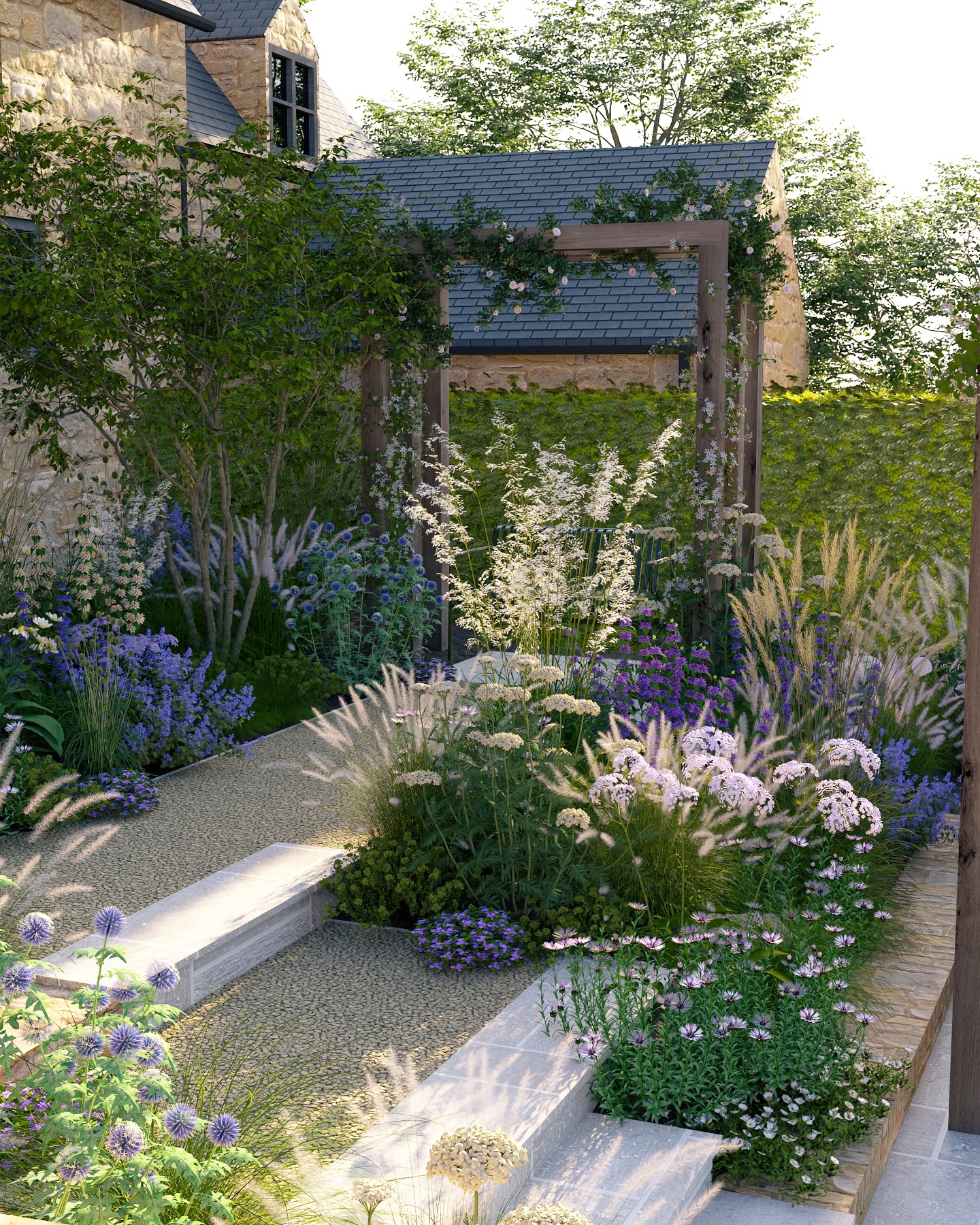
A cottage garden style suits a sloped plot particularly well because the informal, layered quality of the planting naturally accommodates changes in level without requiring precise engineering. The slope becomes part of the character of the garden rather than something to overcome. Lavender and wildflowers tumbling down a gradient, with a stone path cutting through and a vine-covered pergola creating structure — this is a garden that looks like it grew rather than was installed.
The pergola here is doing specific work beyond aesthetics: it creates a destination at one level of the slope, giving the garden a focal point that draws you up the path rather than leaving you standing at the bottom looking up at a bank of planting. Creating destination points at different levels — a seating area, a feature planting, a structure — is one of the most effective ways to make a sloped garden feel like a garden rather than a landscaping project.
9. Wooden Retaining Walls With a Lawn and Treehouse: A Family Slope Done Right
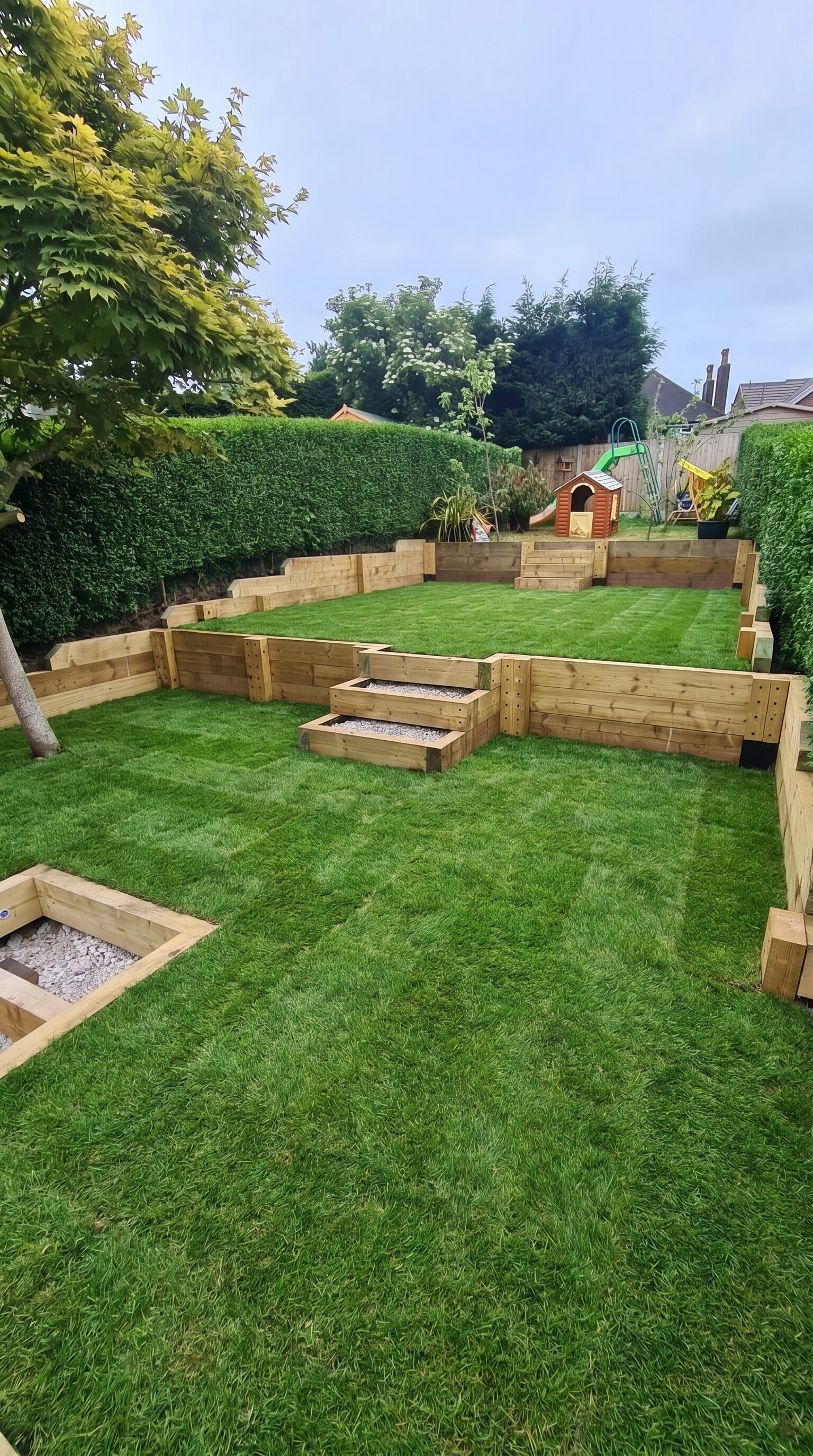
Timber retaining walls creating distinct levels are one of the most family-friendly approaches to a sloped garden because they produce flat usable areas — lawn for playing, patio for seating — out of ground that would otherwise be awkward and underused. The tiered structure also means children have different levels to explore, which adds genuine play value to the garden beyond a flat lawn would provide.
The treehouse here shows how a slope naturally creates the elevated access that makes these structures work — the change in level does part of the engineering for you. The hedge providing privacy at the top and the tidy overall arrangement show that a family garden doesn’t have to sacrifice aesthetics for practicality. These elements can coexist when the design has been thought through from the start.
10. A Sloped Cottage Garden With Lavender Borders and Stone Pathways
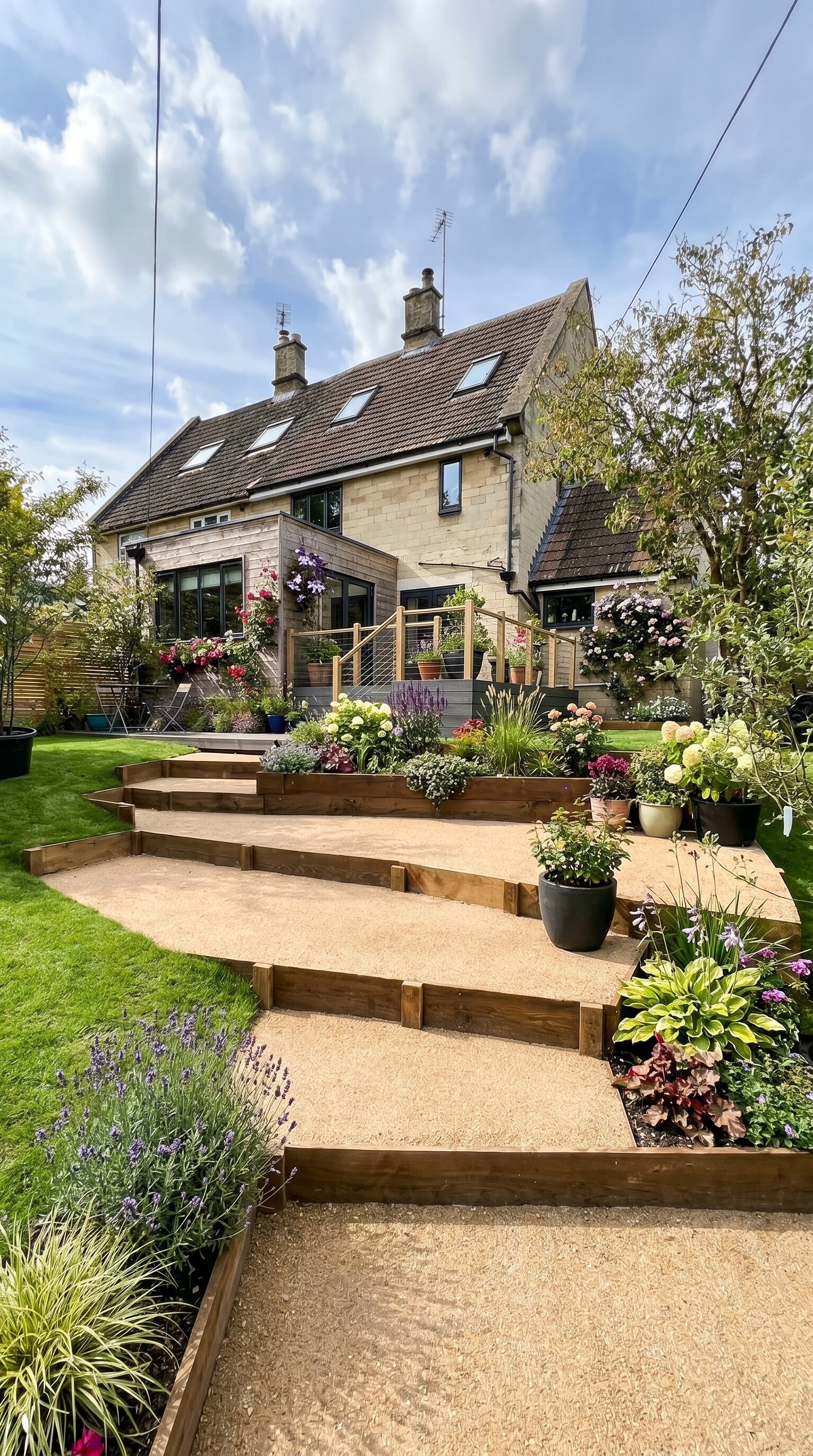
A gently sloping cottage garden with defined paths and layered planting is one of those setups that looks more complex than it is to achieve. The key is the paths — once you have a clear route through the garden that manages the gradient, the planting on either side can be as relaxed and informal as you like. The structure comes from the path; the character comes from the plants.
The patios and decks at different levels here create multiple places to sit and enjoy the garden from different vantage points, which is one of the genuinely underappreciated advantages of a sloped plot. A flat garden has one ground-level perspective; a terraced garden has several. The view from the deck at the top of this garden is completely different from the view at the bottom — and both are worth having.
11. Multi-Tier Wooden Planters With String Lights and a Seating Area
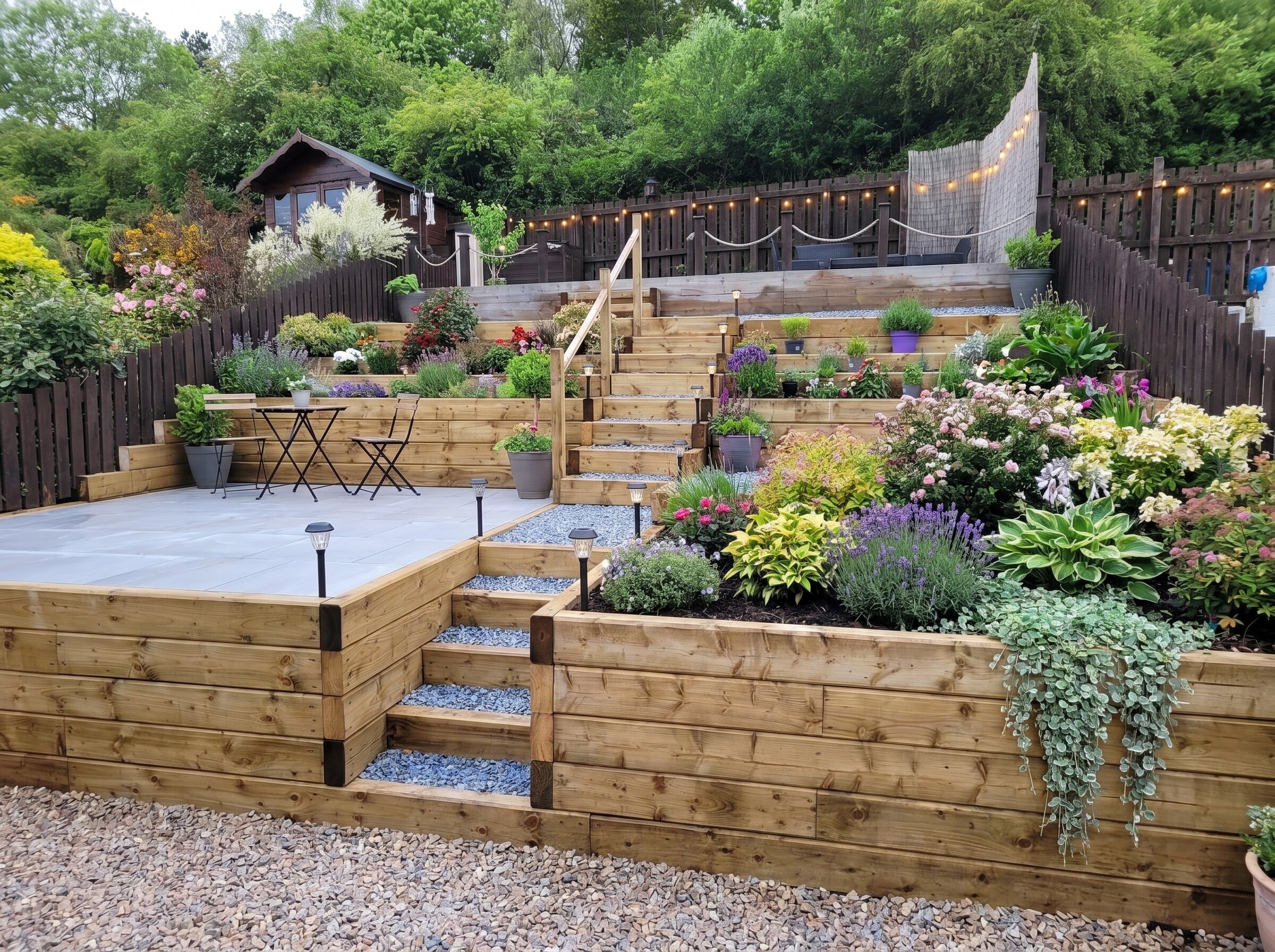
Multi-tier wooden planters built into a slope serve two purposes simultaneously: they retain the soil on each level and create the growing space that a steep slope would otherwise deny you. Packing each tier with different plants — roses, greenery, flowering perennials — produces a wall of colour that’s visible from the seating area below, which transforms what could be a looming slope into a backdrop worth looking at.
String lights above the seating area extend the usability of the garden into the evening in a way that changes how you relate to the space. A garden you can use at night feels genuinely different to one you only see during the day. The stone steps and paths keeping the levels connected and navigable complete a setup that is both practical and genuinely attractive — the kind of result that’s achievable with careful planning rather than a large budget.
12. Wooden Terraced Planters With Stone Steps and a Lawn at the Base
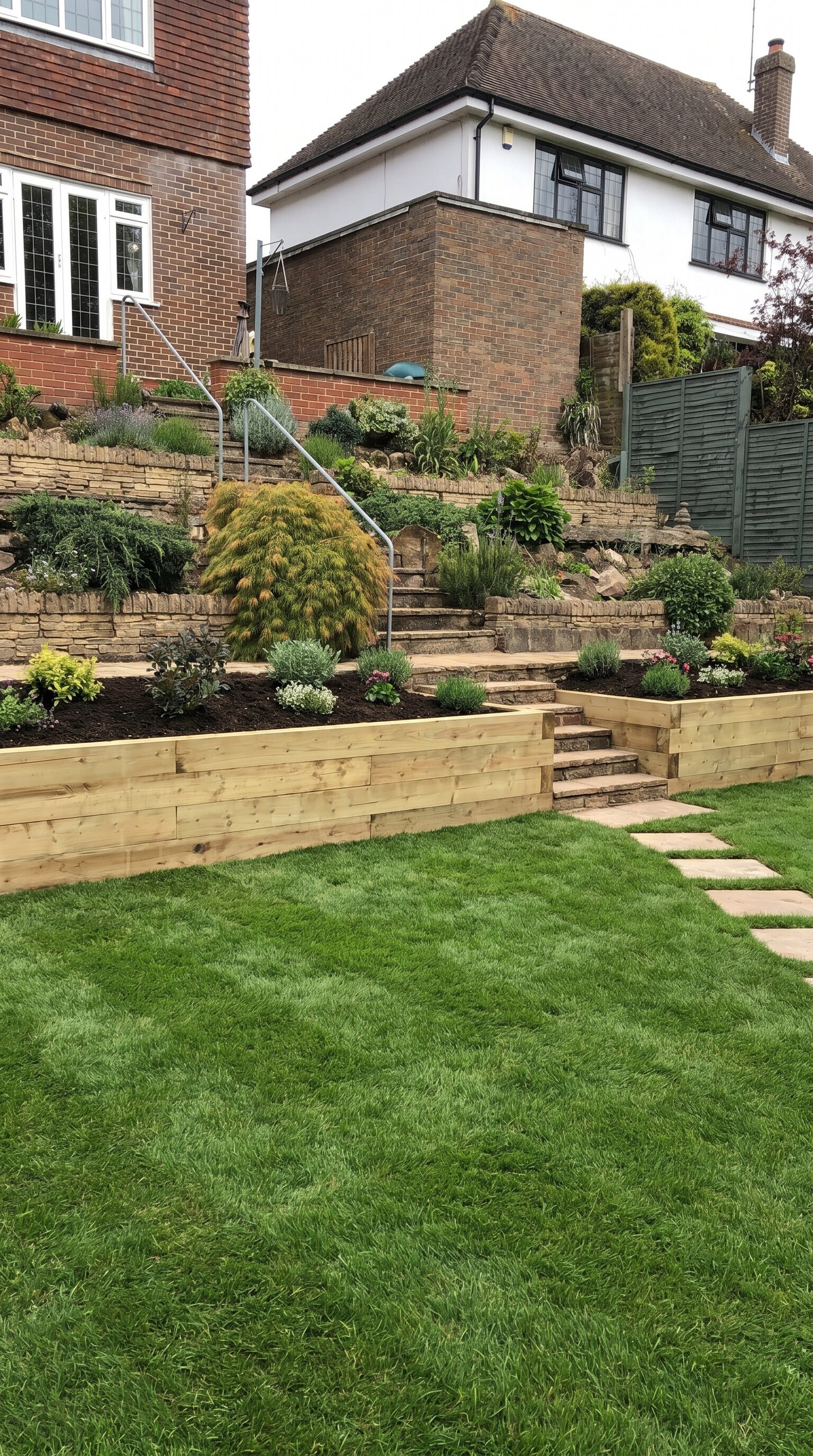
This is one of the cleaner, more considered approaches to a steep slope — wooden planters creating distinct levels at the top, stone steps providing access between them, and a flat lawn at the base giving the garden a usable open area at its lowest point. Each element is doing a specific job and the combination reads as a complete, resolved design rather than a collection of individual solutions.
The concrete stepping stones across the lawn are a detail worth noting. They suggest that the garden is genuinely used rather than just looked at — there’s a route across the space that people actually walk. A garden that has been designed for use always looks more alive than one designed purely for appearance, and the stepping stones signal that this garden was thought about from the perspective of someone living in it rather than photographing it.
13. Natural Stone Winding Steps With Garden Lighting: The Evening Garden on a Slope
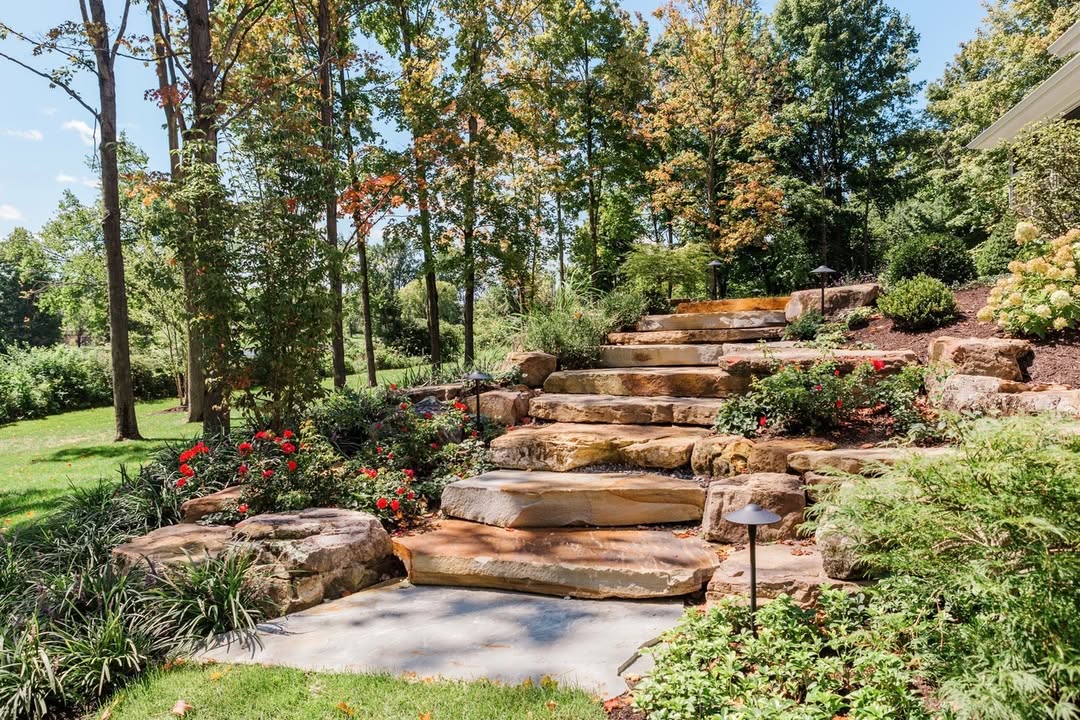
A winding stone staircase on a slope is one of those features that looks like it required significant expertise but is largely a matter of patience and the right material. Natural irregular stones set into the hillside and mortared in place create a path with a quality of inevitability — it looks like it was always there, which is the mark of good hard landscaping. The winding line rather than a straight run makes the ascent feel more like a garden journey and less like a functional access route.
The garden lighting dotted along the path is worth considering from the outset rather than adding later. Steps on a slope need to be safely lit after dark, and ground-level path lights that cast light downward are both effective and unobtrusive. Planning for them during construction — running the cable before the steps are in place — costs very little and means the garden can be properly enjoyed in the evenings from the day it’s finished.
14. Stone-Walled Terraces With Vegetable Beds: The Productive Sloped Garden Done Well
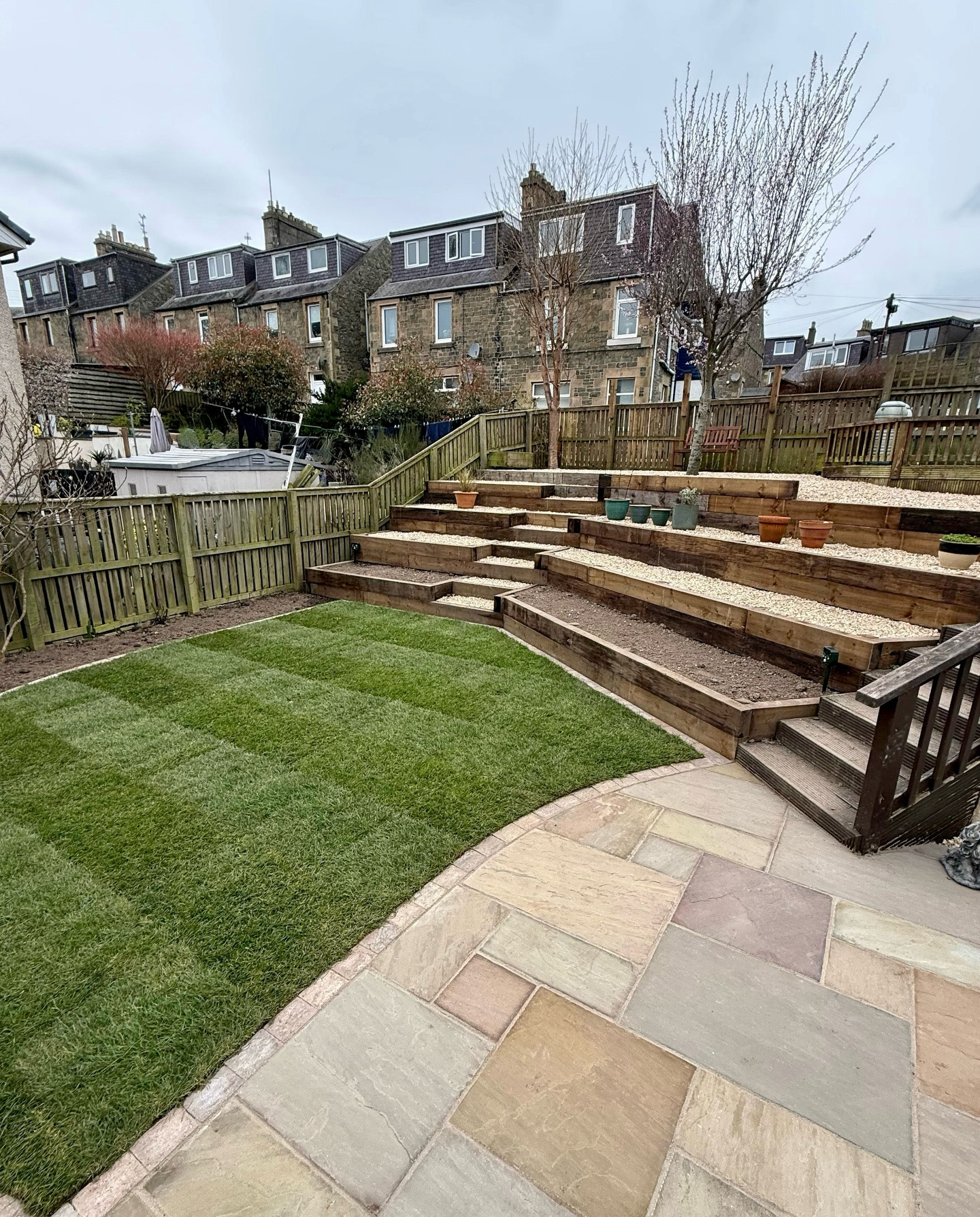
Stone retaining walls creating vegetable growing terraces on a slope is one of the most practical and historically proven approaches to sloped garden design — it’s essentially the same principle that terraced agriculture has used for thousands of years, applied at a domestic scale. Each tier creates a deep, well-drained growing bed that’s far more productive than trying to cultivate on the slope itself, and the walls prevent soil erosion that would otherwise strip the beds bare over time.
The tomatoes visible in the upper beds are a useful reminder that a south-facing slope captures more sun than a flat garden at the same latitude — the angle of the slope toward the sun increases heat and light in a way that genuinely extends the growing season. The wooden fence and steps completing the scheme give the whole garden a warm, working quality that suits a productive kitchen garden well.
15. A Clean Stone Retaining Wall With Lawn and Shrubs: Simple and Reliable
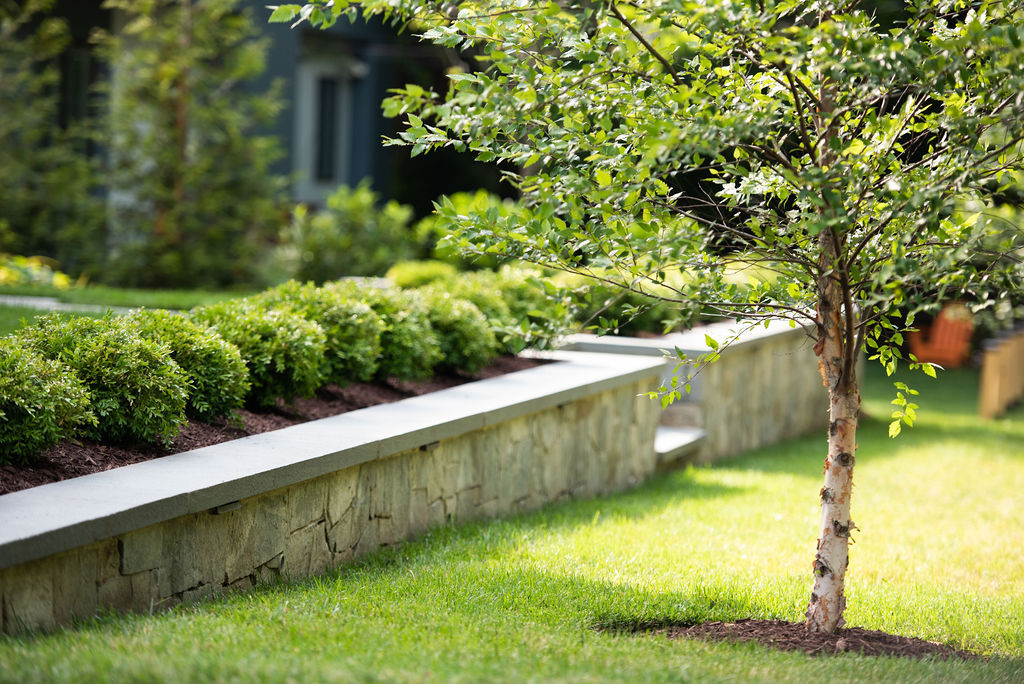
Sometimes the right answer for a gentle slope is a single well-built retaining wall that creates one flat lawn area rather than multiple terraces. This approach works particularly well when the slope isn’t extreme — enough of a change in level to be awkward, not enough to demand complex engineering. One good wall, a level lawn, a line of well-maintained shrubs along the top: clean, simple, effective.
The polished stone wall surface here and the neat shrub line along its top give the garden a contained, resolved quality that feels intentional without being fussy. A small tree planted alongside the wall provides scale and stops the scheme from feeling too minimal. This is a useful reminder that not every sloped garden needs an elaborate multi-level treatment — sometimes one considered intervention is all it takes.
16. A Sloped Driveway and Front Yard: When the Grade Works in Your Favor
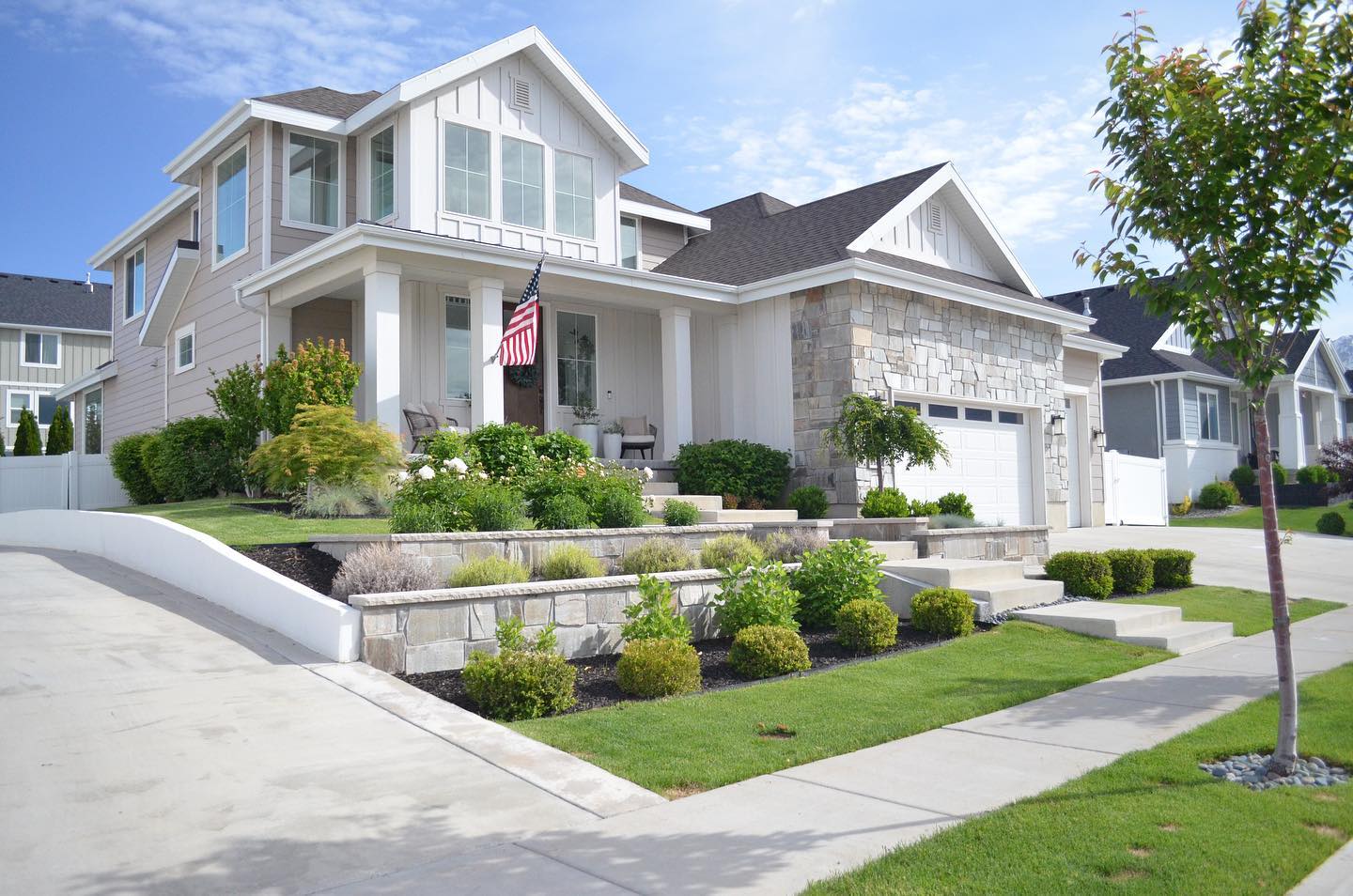
A sloped driveway is one of those features that seems like a problem until you realize that the elevation change is what gives the house its presence from the street. A house sitting above road level looks more substantial and more private than one at grade — you have to ascend to reach it, which creates a small but real sense of arrival. The slope is doing something positive here that a flat lot couldn’t replicate.
The clean front yard treatment — manicured lawn, trimmed shrubs, a well-defined driveway edge — keeps the focus on the house rather than the planting. For a front yard on a slope, simplicity is usually the right approach: too many elements on a gradient reads as cluttered rather than lush. The clear lines and restrained plant palette here make the most of the slope without the garden competing with the architecture for attention.
17. Geometric Stone Terraces With Vegetable Growing Beds and Wooden Steps
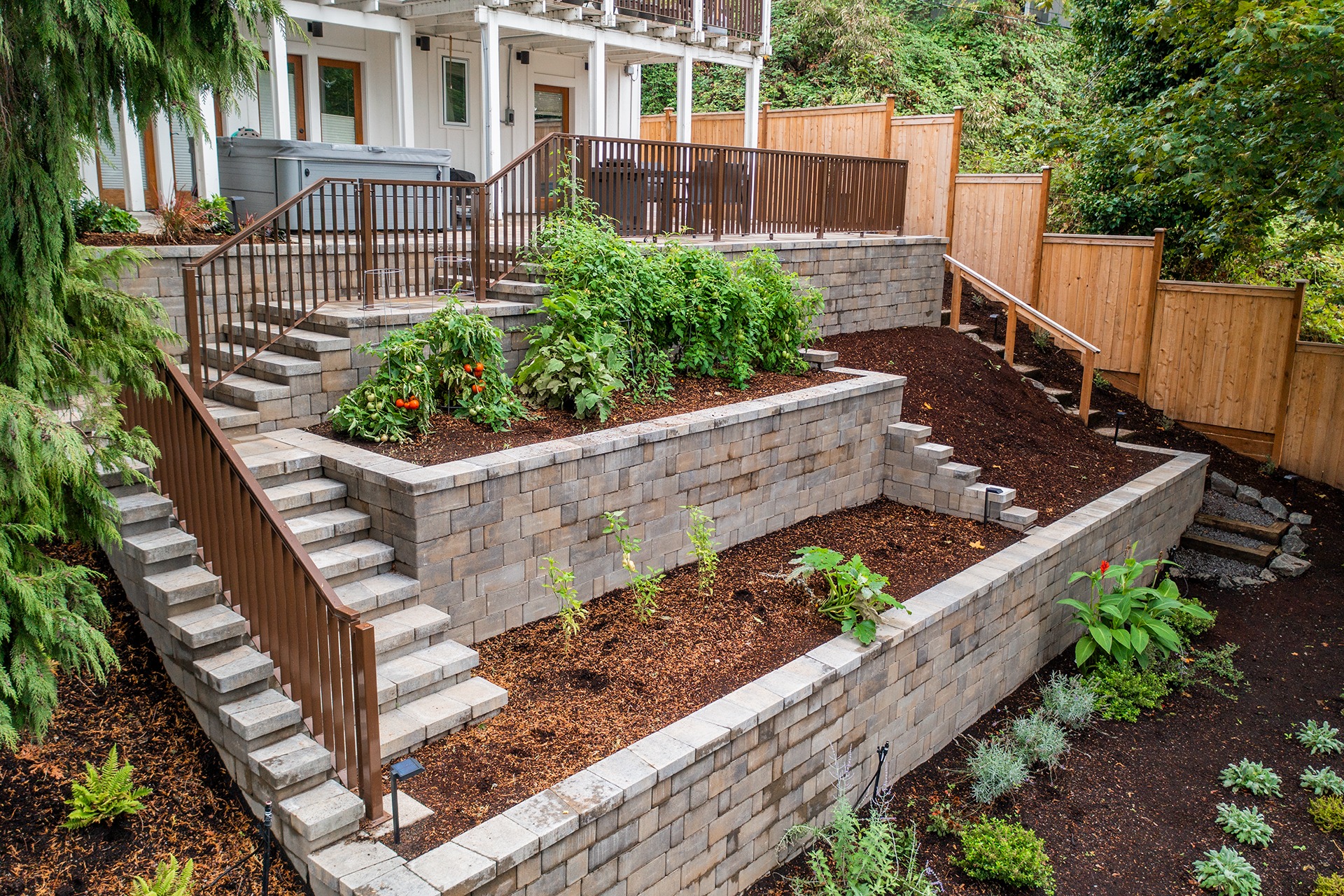
Geometric stone terrace walls have a precision that suits a contemporary garden aesthetic — the clean right angles and smooth faces of cut stone read as deliberate and architectural rather than rustic or informal. Paired with productive planting, the formality of the structure and the looseness of growing vegetables and herbs create a productive tension that makes the garden interesting to look at while also being genuinely useful.
The wooden steps between levels and the railing alongside provide access that’s both safe and warm-toned against the grey stone. A purely stone staircase can feel cold and hard; the timber introduces natural warmth and a slight contrast that stops the garden feeling like a construction project. The surrounding wooden fence enclosing the whole space gives it a contained, manageable quality — a productive garden that’s clearly looked after and enjoyed.
18. Tiered Stone Walls With Agave and Native Planting: The Low-Water Sloped Garden
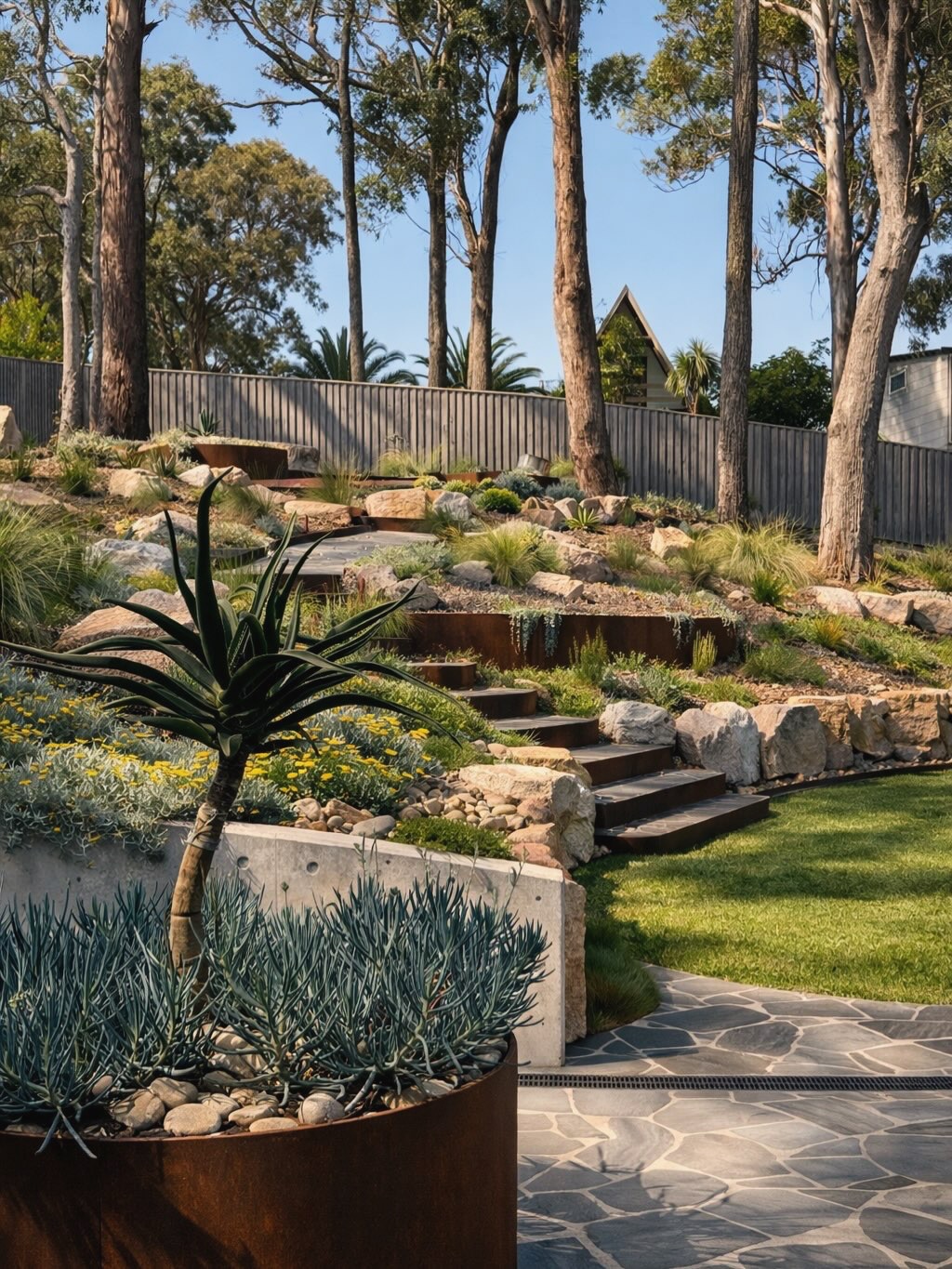
A sloped garden planted with drought-tolerant and native species is one of the most sensible approaches available, particularly in areas with dry summers. The slope itself aids drainage, which combined with plants that prefer free-draining conditions means very little supplementary watering is needed once everything is established. Large rocks scattered through the planting beds both look natural and help retain what moisture the soil does receive.
The agave in the metal planter on the patio is a considered detail that bridges the gap between the structured hard landscaping and the wilder planted slope. An architectural plant in a statement container at the transition between patio and garden signals that the design has been thought about at every level. The curved wooden fence softening the boundary at the top completes a garden that manages the slope while looking genuinely relaxed and natural.
19. A Flat Deck With a Water Feature and Hedge: Creating Calm From a Difficult Slope
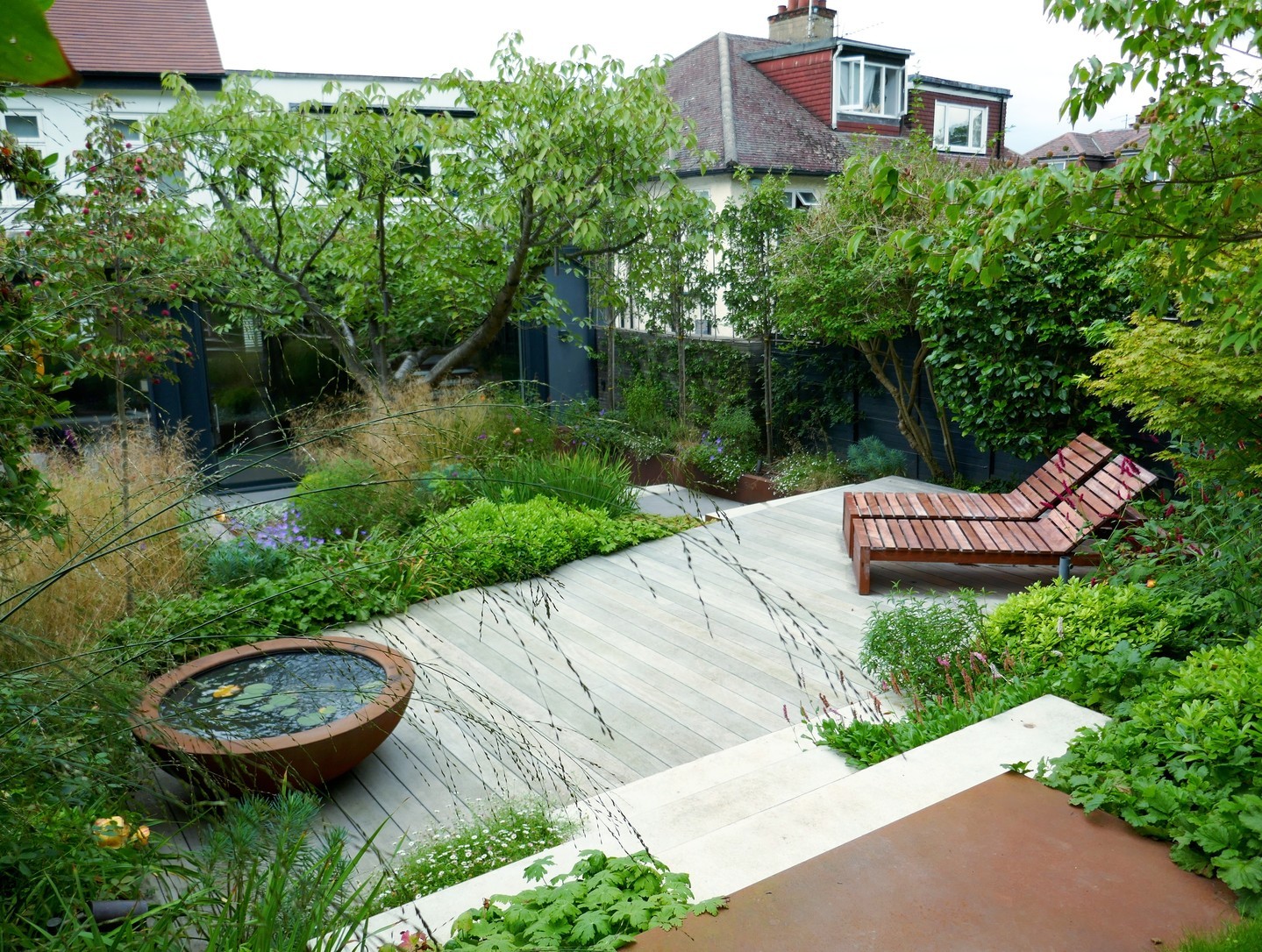
Building a level deck over a slope rather than into it is one of the most practical approaches for a steeper gradient — you avoid the expensive earthworks of terracing and get a usable flat surface relatively quickly. The slope simply falls away beneath the deck structure, and the garden underneath can be planted with shade-tolerant groundcovers that require no maintenance. The deck becomes the primary outdoor living space.
The bowl-shaped water feature here adds a calming quality that makes the deck feel like more than a functional platform. A water feature on a level surface within a sloped garden has a particular kind of visual contrast — the stillness of the water against the movement of the gradient around it. Dense hedging and mature shrubs completing the enclosure give the whole space a sense of being a private, considered place rather than a structural solution to a difficult site.
20. A Slide and Climbing Wall Built Into the Slope: When Children’s Play Justifies the Grade
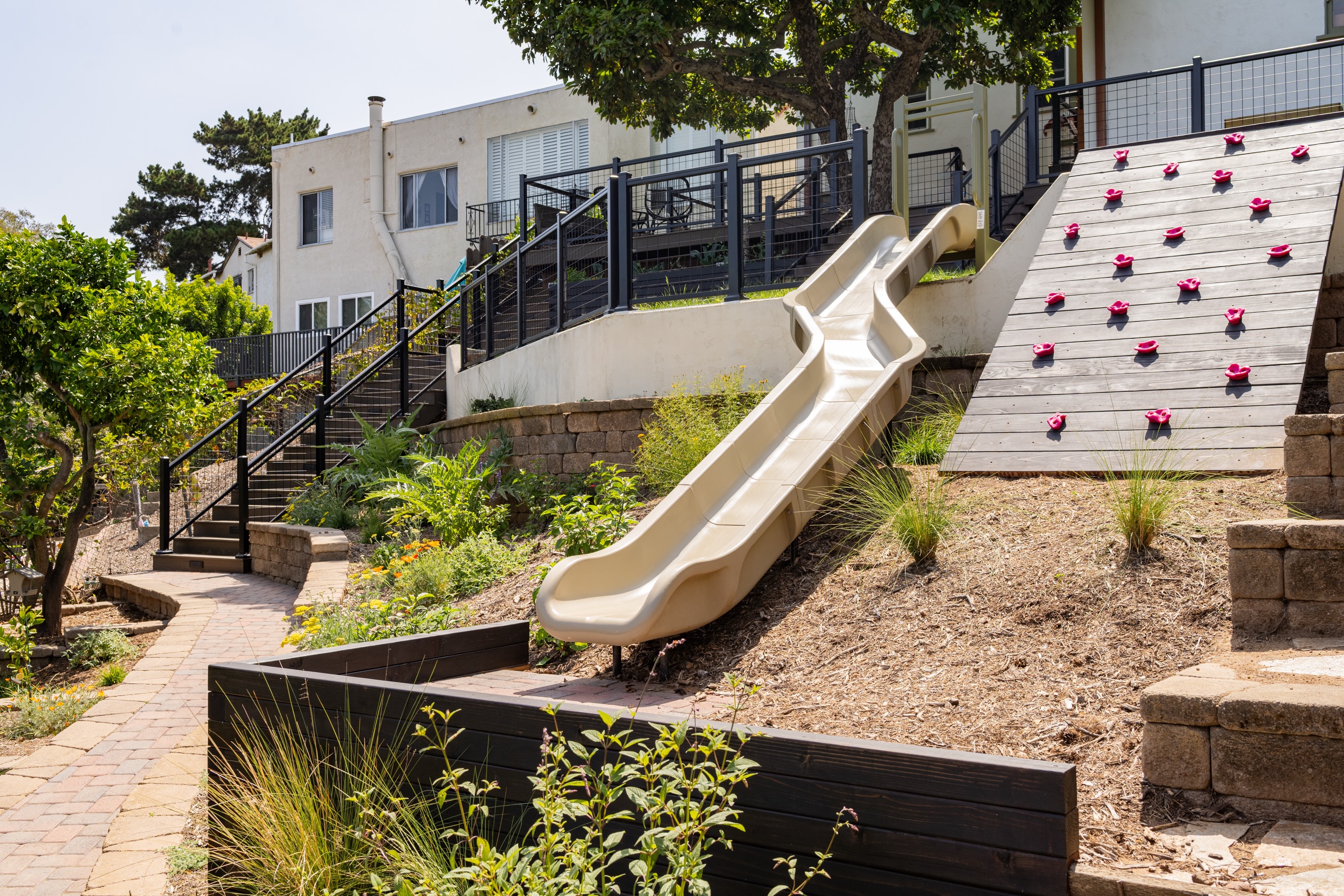
A slope is ideal for a children’s play area in a way that a flat garden simply isn’t. The gradient provides the height that a slide needs without requiring a standalone structure, and a climbing wall on the slope face uses what would otherwise be a difficult-to-plant steep bank. The slope stops being a problem and becomes the feature that makes the play area possible.
The integration of the slide and climbing wall into the landscape rather than on top of it is what makes this work visually. These elements don’t look like they were placed in a garden — they look like the garden was designed around them from the start. The tidy stone steps, modern railing and well-maintained lawn alongside ensure that the play area doesn’t take over the whole garden but exists as one well-considered part of a coherent outdoor space.
21. Curved Stone Walls, a Level Lawn and Outdoor Dining: A Slope Transformed Into a Garden Room
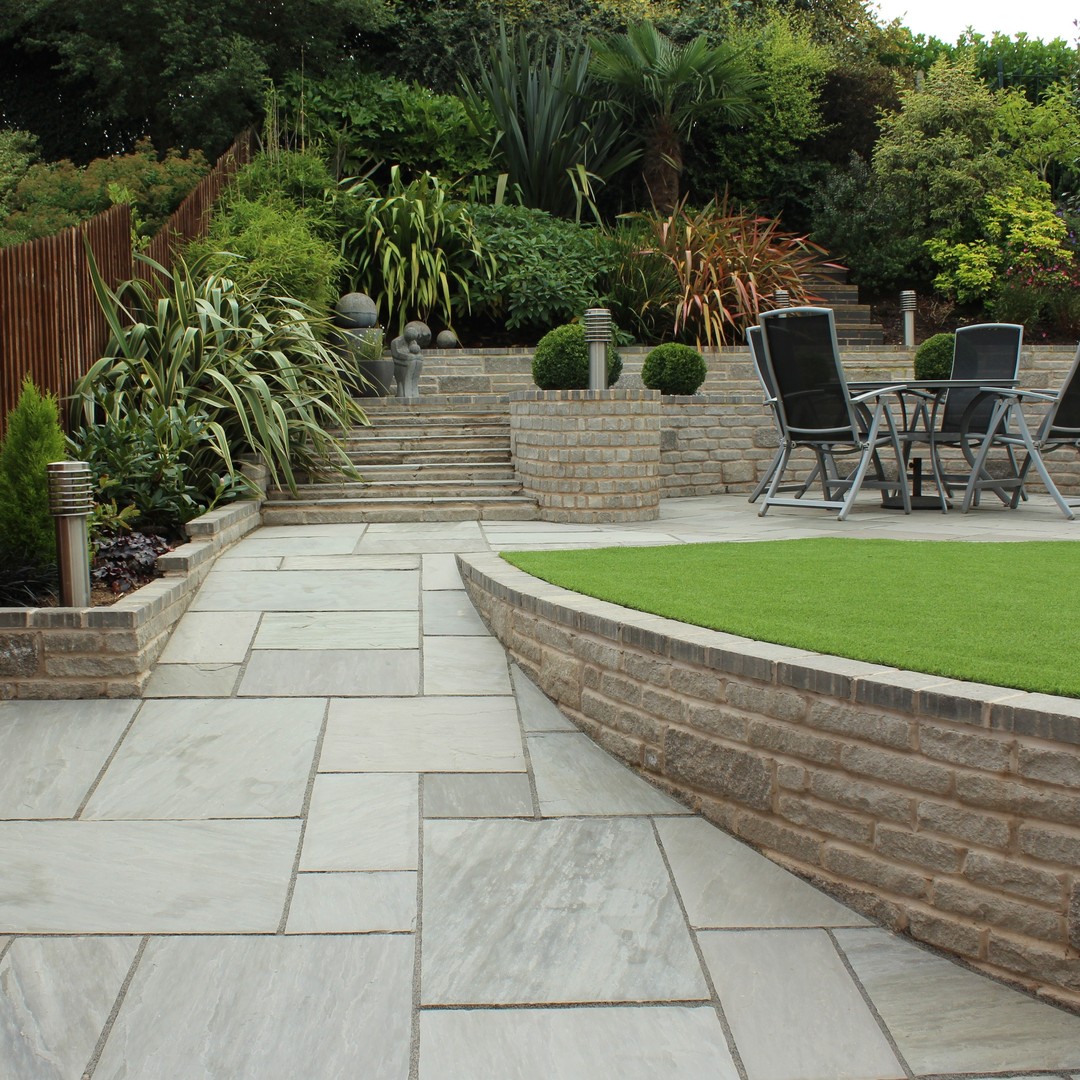
Curved retaining walls rather than straight ones transform a necessary structural element into a genuine design feature. The curve gives the garden a fluid quality that straight walls can’t provide and creates a more natural-looking transition between levels. Combined with grey paving, a level lawn area and outdoor furniture, the terracing here produces something that feels less like an engineered slope and more like a deliberately composed outdoor room.
The dining table positioned in the paved area with steps and planted terraces rising behind it creates a backdrop for outdoor entertaining that a flat garden would never naturally provide. This is one of the strongest arguments for working with a slope rather than fighting it — the change in level gives a dining space a sense of being contained and sheltered without any additional screening. The planting on the upper levels frames the view from the table in a way that makes the whole outdoor space feel more complete.
22. Wide Stone Steps With Sleek Walls and Garden Lighting: The Formal Sloped Garden
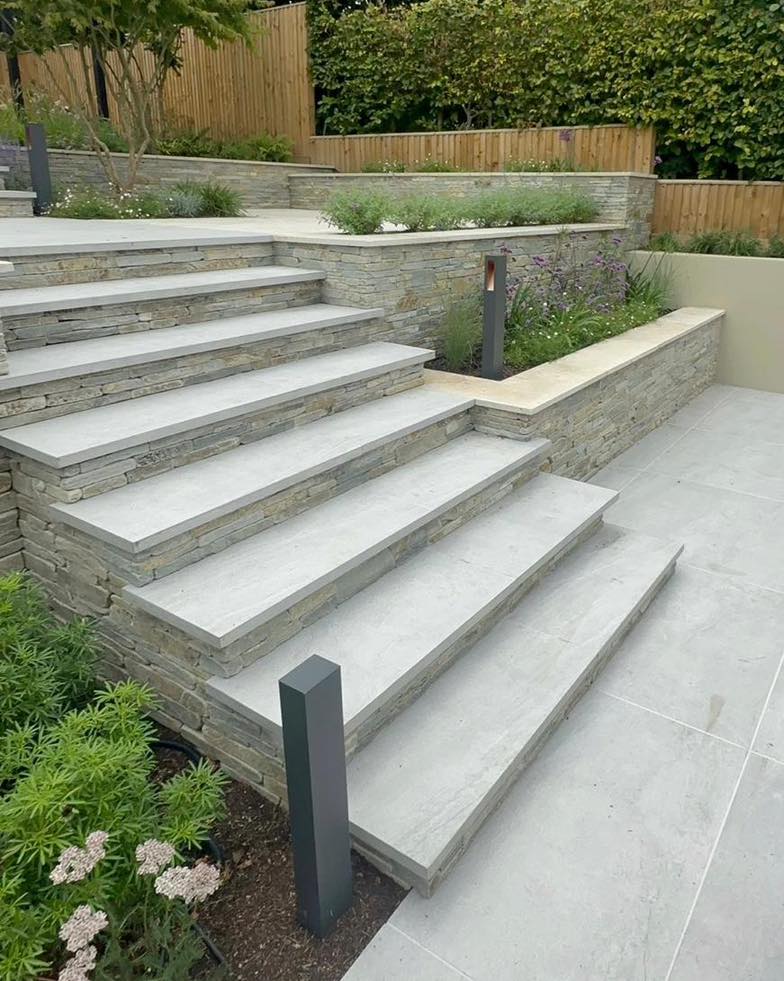
Wide, generous stone steps on a slope do something that narrow steps can’t: they make the ascent feel unhurried and purposeful rather than functional and steep. Broad steps invite you to slow down, which changes the whole quality of moving through a sloped garden. Paired with slate-grey walls in the same tonal range as the steps, the result is a formal, resolved design that has genuine ambition.
Modern lighting fixtures integrated into the walls are a design detail that contributes to both safety and atmosphere. Lighting a sloped garden well is more important than lighting a flat one because the changes in level need to be clearly readable after dark. Wall-mounted fixtures that cast light downward onto the steps are more elegant and more effective than ground-level path lighting, and they read as part of the garden’s design rather than a safety afterthought added at the end.